

TL;DR:
- Most South Florida homeowners face delays and cost overruns during full renovations, which are preventable with proper planning. A typical project takes 6 to 18 months, requiring careful sequencing, permits, and regional code compliance, especially for HVHZ requirements. Hiring experienced local contractors and managing timelines proactively ensures smoother projects and better outcomes.
Many South Florida homeowners start their renovation with excitement and a Pinterest board, only to find themselves three months in, still waiting on permits, watching costs climb, and wondering where everything went sideways. The good news: most of that pain is preventable. This guide walks you through every critical phase of a full home renovation, from initial planning and budgeting to permits, contractor selection, and final inspection. You'll get concrete benchmarks, South Florida specific advice, and the kind of practical guidance that keeps your project on track from day one.
Table of Contents
- Understanding the renovation journey: Key phases and timeline
- Budgeting and contingency planning: Setting realistic expectations
- Permits, codes, and South Florida requirements
- Hiring the right contractor and project sequencing
- Inspections, punch list, and project closeout
- What most guides miss: The realities of South Florida renovations
- Ready to renovate? Get expert help for your South Florida home
- Frequently asked questions
Key Takeaways
| Point | Details |
|---|---|
| Set realistic timelines | Expect your renovation to take 6 to 18 months, factoring in design, permits, and construction. |
| Budget for overages | Plan a 10-20 percent contingency fund, as sticking exactly to your base budget is rare. |
| Understand regional codes | South Florida requires strict compliance with HVHZ and Miami-Dade NOA, so research permits early. |
| Vet your contractors | Use licensed, insured pros with local experience, and check their code compliance records in advance. |
| Don't skip the punch list | Document every issue before final payment to ensure top-quality results and avoid later regrets. |
Understanding the renovation journey: Key phases and timeline
Every successful renovation starts with one thing: knowing what you're actually getting into. A full home renovation is not a weekend project or even a two-month undertaking. It is a multi-phase effort that requires careful sequencing, and in South Florida, factors like hurricane season and regional building codes add real complexity that most national guides simply ignore.
Full home renovations in South Florida typically take 6 to 18 months from design through completion, broken down as roughly 6 to 10 weeks for design, 4 to 8 weeks for permitting, and 12 to 32 weeks for actual construction. That range is wide because it depends on your scope. A kitchen and master bath overhaul will run differently than a complete structural gut renovation.
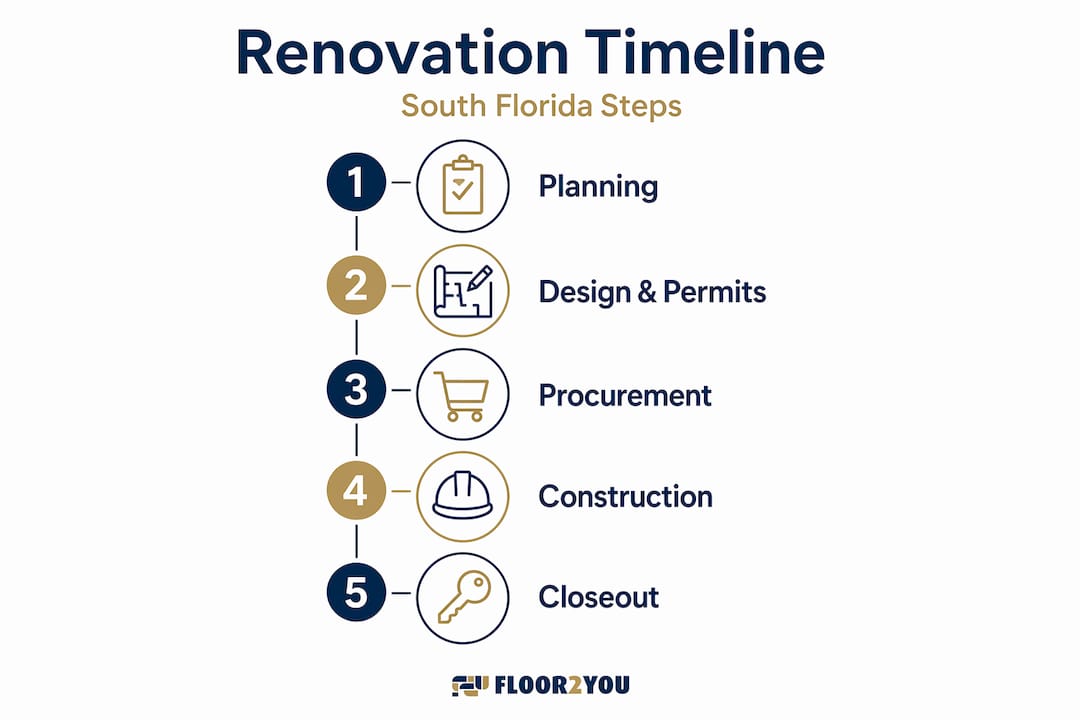
The step-by-step project flow follows these major phases: Planning (goals and budget), Design and Permits, Procurement, Construction (rough-to-finish), and Inspections, Punch List, and Closeout. Experts recommend adding a 10 to 20% timeline buffer to every phase, not because contractors are slow, but because inspections get rescheduled, materials arrive late, and Florida's weather is unpredictable.
Here's a realistic phase breakdown for a South Florida full home renovation:
| Phase | Typical Duration | Key Milestones |
|---|---|---|
| Planning and design | 6 to 10 weeks | Goals set, drawings completed |
| Permitting | 4 to 8 weeks | Approved permits in hand |
| Procurement | 2 to 6 weeks | Materials ordered and scheduled |
| Construction | 12 to 32 weeks | Rough-ins, finishes, HVAC, flooring |
| Closeout and inspections | 2 to 4 weeks | Final walk, punch list resolved |
Sequencing trades is one of the most overlooked skills in renovation project management. In South Florida, this matters even more because licensed subcontractors are in high demand, especially ahead of hurricane season. If your drywall goes up before electrical rough-in inspections, you'll pay to tear it back out. If you order custom cabinetry late, your kitchen sits in a holding pattern for weeks. When you work with us to plan a home remodel correctly from the start, you eliminate most of those scheduling landmines before they ever detonate.
Understanding which types of home renovations you are taking on also shapes your timeline decisions. Kitchen remodels, bathroom overhauls, and full flooring replacements each carry their own sequencing logic and lead times.
Budgeting and contingency planning: Setting realistic expectations
With the stages mapped out, it's time to get brutally honest about what full-home renovations can cost, and how to safeguard your investment.
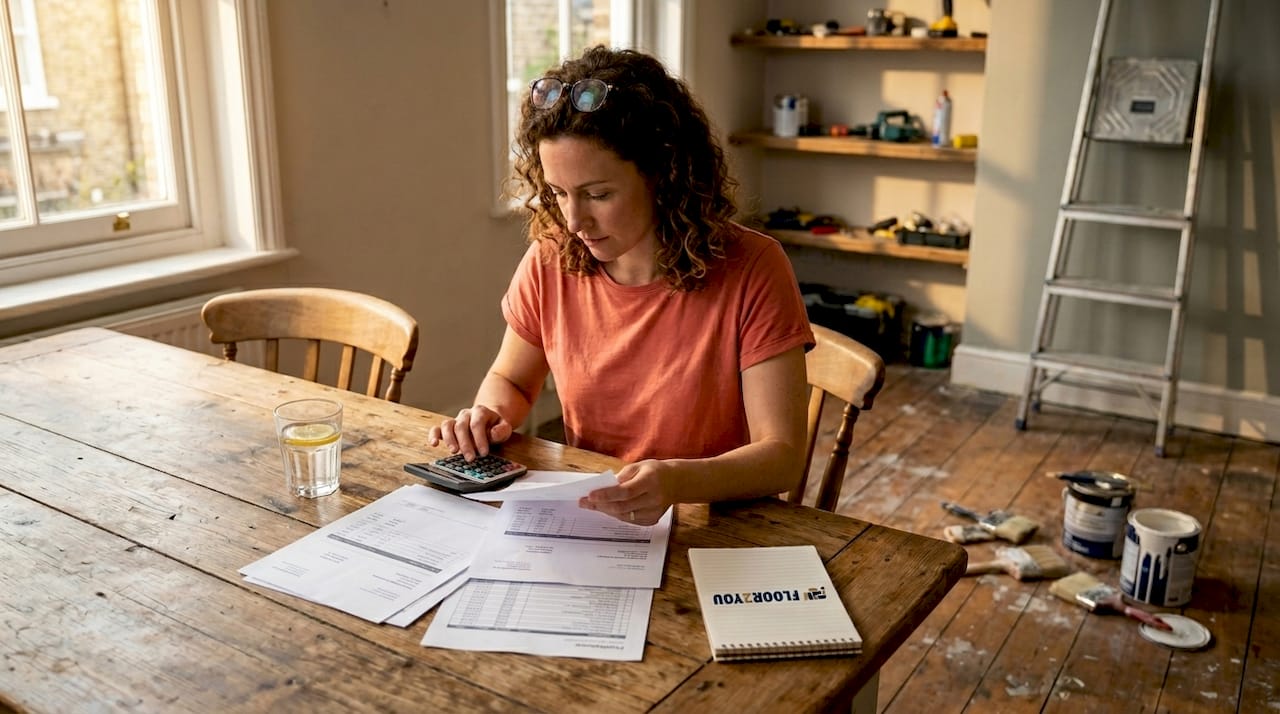
The numbers might surprise you. According to budget planning research, only 34% of homeowners actually stick to their original renovation budget. The median kitchen remodel runs $24,000, and whole home renovations commonly exceed $100,000. A 10 to 20% contingency fund is not optional; it is the financial safety net that keeps your project alive when the unexpected happens.
Why do budgets blow? Usually for three reasons: hidden conditions discovered during demo (rotted subfloor, outdated wiring, mold), scope creep where you upgrade selections mid-project, and delayed procurement that forces rush orders at premium prices. South Florida adds a fourth reason: code-required upgrades. If your older home's electrical panel doesn't meet current capacity for modern HVAC, you're replacing it whether you planned to or not.
| Renovation category | Typical South Florida cost range |
|---|---|
| Full kitchen remodel | $20,000 to $60,000+ |
| Master bathroom | $15,000 to $40,000+ |
| Flooring (whole home) | $8,000 to $25,000+ |
| HVAC replacement | $8,000 to $15,000 |
| Whole home renovation | $100,000 to $400,000+ |
A Houzz study on renovation trends confirms kitchens consistently top the renovation priority list with that $24,000 median, and that homeowners who track project KPIs like time and cost variances throughout the build see far better outcomes than those who don't.
Pro Tip: Break your budget into three buckets. First, your baseline cost for planned work. Second, your contingency reserve (15% minimum in South Florida, not 10%). Third, a wish list fund for optional upgrades. That way, you never dip into contingency to pay for a countertop upgrade you just decided you wanted.
Tracking spending weekly rather than monthly catches overruns before they become crises. Use a simple spreadsheet or a project management app and compare actual spend to your plan every Friday. For more detail on how costs translate to long-term value, explore our remodeling costs and value breakdown.
Permits, codes, and South Florida requirements
Even the best plans and budgets can be derailed if you're not prepared for South Florida's unique permitting and code environment.
Florida has building requirements that go well beyond what most national renovation articles describe. South Florida sits in the High Velocity Hurricane Zone (HVHZ), a designation covering Miami-Dade and Broward Counties that triggers some of the most rigorous building code standards in the entire country. These aren't technicalities. They're rules that exist because homes in this region have to survive hurricane-force winds.
Here are the key permit requirements for South Florida full renovations:
- Structural permits are required for any work affecting load-bearing walls, roof modifications, additions, or foundation changes.
- Electrical permits cover panel upgrades, new circuits, rewiring, and any new fixture installations beyond simple replacements.
- Plumbing permits apply to new drain lines, supply lines, water heater replacements, and any fixture relocation.
- Mechanical permits govern HVAC installation, ductwork modifications, and ventilation changes.
- Impact window and door permits require Miami-Dade NOA approval (Notice of Acceptance), which is a specific product-level certification proving the window or door meets HVHZ wind resistance standards.
According to Florida construction permit guidelines, the permitting process in South Florida typically takes 4 to 8 weeks, and working with a licensed general contractor (GC) rather than pulling owner-builder permits is strongly advisable. When a licensed GC pulls permits, the liability for code compliance shifts substantially to them. When you pull owner-builder permits yourself, you personally carry the risk of code violations, failed inspections, and future resale complications.
"Skipping permits is one of the most expensive shortcuts a homeowner can take. In South Florida, an unpermitted renovation can result in stop-work orders, mandatory demolition of completed work, and serious complications when you try to sell your home."
Pro Tip: Ask your contractor to walk you through every permit they plan to pull before signing the contract. A good contractor is transparent about this. If someone tells you a job "doesn't need a permit" and your gut says otherwise, call your local building department directly and verify.
Hiring the right contractor and project sequencing
Getting your paperwork squared away is half the battle. The team you hire and the way you schedule them changes the entire outcome of your remodel.
Choosing a contractor in South Florida is not just about price. It's about licensing, experience with local codes, and their ability to sequence trades without creating costly overlaps or idle gaps. Here's how to approach the selection process:
- Verify licensing through Florida DBPR (Department of Business and Professional Regulation). Every legitimate contractor in Florida has a searchable license number.
- Get 3 to 5 bids on the same detailed scope of work. Comparing bids apples-to-apples reveals who's missing something and who's padding unnecessarily.
- Check insurance certificates for both general liability and workers' compensation. If a subcontractor gets hurt on your property and your GC has no workers' comp, you may be liable.
- Call references and specifically ask: "Did they stay on schedule? How did they handle problems?"
- Confirm HVHZ experience. Any contractor working in Miami-Dade or Broward who can't speak fluently about HVHZ compliance is a red flag.
For contractor vetting tips and what questions to ask, doing your homework before signing saves enormous headaches later.
Once hired, the right contractor follows a disciplined trade sequence. According to South Florida renovation experts, the standard build-out order looks like this:
- Demolition and structural work
- Framing modifications
- Rough-in plumbing, electrical, and HVAC
- Inspections on rough work before closing walls
- Insulation
- Drywall and plaster
- Tile, flooring, and cabinetry installation
- Finish electrical and plumbing (outlets, fixtures, faucets)
- Painting and trim
- Final fixtures, appliances, and hardware
Skipping or reordering any of these steps creates rework. Rework costs money and time. Our remodeling workflow guide breaks down this sequence in even more detail for bathroom projects specifically, but the logic applies across every room.
Inspections, punch list, and project closeout
Once every trade has done their work and the finish line is in sight, using a formal closeout process protects your investment and peace of mind.
Most homeowners underestimate how much work happens after construction "finishes." The closeout phase is where you protect the quality of everything that came before it. It starts with inspections and ends with a fully resolved punch list.
Follow these steps to close out properly:
- Schedule final inspections for every permitted trade: electrical, plumbing, mechanical, and structural as applicable. Your GC should coordinate these and track the status of each.
- Do a formal walkthrough at substantial completion (when the work is essentially done but not yet 100%) with your contractor and a written punch list in hand.
- Document every deficiency with photos and written descriptions. A typical single-home renovation punch list contains 50 to 150 items, including things like paint touch-ups, door alignment issues, caulking gaps, and hardware that isn't flush.
- Set a resolution timeline with your contractor, usually 1 to 3 weeks for a full punch list.
- Withhold final payment until all punch list items are resolved and your final inspections pass. This is your most powerful tool for ensuring everything gets done right.
"Releasing final payment before the punch list is resolved is one of the most common and costly mistakes homeowners make at the end of a renovation. Once the money is released, your leverage disappears."
The complete renovation checklist approach recommends treating the punch list phase as its own mini-project, not an afterthought. Assign deadlines to each item, get written confirmations when they're resolved, and do a final walkthrough before you sign off.
What most guides miss: The realities of South Florida renovations
You've seen the steps. Now let's cut through the noise and talk about what really makes or breaks a South Florida renovation.
Most national renovation guides are written for homeowners in places where the biggest concern is a cold snap delaying a concrete pour. Here, you're contending with hurricane season, an inspector backlog that peaks in spring, and a supply chain that stretches through ports sensitive to tropical weather. Optimistic renovation guides tend to emphasize the planning side without fully accounting for the execution realities specific to this region.
Here's what we've learned from working on South Florida projects: the biggest regrets homeowners express aren't about design choices. They're about timing and team selection. Homeowners who started a gut renovation in June with a general contractor who had never worked in HVHZ territory consistently faced the worst outcomes: wrong window installations, failed inspections, and months of delay sorting out code corrections.
The most important lesson? Order long-lead items before your permits are even approved. Custom cabinetry, impact windows and doors, specialty tile, and certain HVAC units can take 10 to 16 weeks. If you wait until permits are in hand to place those orders, you'll hit a construction dead zone while materials make their way to your job site.
Professional project management is not a luxury for large renovations. It is a function that keeps the entire sequence tight, catches ordering errors early, and maintains the contractor schedule so no trade sits idle waiting on another. Homeowners who try to manage 6 to 8 subcontractors on their own while working full-time jobs almost always describe it as their biggest regret. The savings rarely outweigh the cost of errors and delays.
For expert remodeling tips that go beyond surface-level advice, understanding the full financial and logistical picture is what separates a smooth project from a nightmare one.
Ready to renovate? Get expert help for your South Florida home
With a proven roadmap in hand, you're ready to start your transformation, and the right local partner makes every phase faster, smoother, and less stressful.

At Floor2You, we work with South Florida homeowners every day who are planning exactly the kind of full home renovation this guide covers. We understand HVHZ requirements, local permitting timelines, and the kind of trade sequencing that keeps projects on budget and moving forward. Whether you need premium flooring installation, a complete kitchen or bathroom remodel, or comprehensive project management from first call to final walkthrough, our team is ready to help. Reach out through our contact form at floor2you.com for a fast, no-pressure quote and local expertise you can actually count on.
Frequently asked questions
How long does a full home renovation take in South Florida?
Most full home renovations here take between 6 and 18 months from the start of design to the final walkthrough, depending on project scope and permitting speed.
What is the average cost of a whole house renovation?
The median kitchen remodel runs about $24,000, while whole home renovations in South Florida commonly exceed $100,000 once all trades and finishes are factored in.
Which permits do I need for my South Florida renovation?
You'll need permits for structural, electrical, and plumbing work, and HVHZ mandates Miami-Dade NOA compliance if you are installing impact-rated windows or doors in Miami-Dade or Broward County.
How should I document issues before my renovation is finished?
Create a written punch list with photos at substantial completion and require your contractor to resolve deficiencies before you release final payment, typically within 1 to 3 weeks.
Is it better to hire a general contractor or manage trades myself?
Hiring a licensed general contractor provides better code compliance, liability coverage, and project coordination, though it costs more than DIY trade management, which carries higher risk of permit issues and quality gaps.