

TL;DR:
- Remodeling investments should align with current home market value to maximize return on investment.
- Projects like garage doors, entry doors, and minor kitchen or bathroom updates often yield the highest resale benefits.
- Over-improvement and exceeding 10-30% of your home's value can lead to poor financial outcomes and diminished ROI.
Most homeowners assume that any remodel automatically adds value. Spend more, get more back. That's the logic, anyway. But the data tells a different story. Understanding why consider home value when remodeling is the difference between a renovation that pays off and one that leaves you thousands of dollars short at closing. The impact of remodeling on home value varies wildly depending on project type, budget, and how your home compares to others in your neighborhood. This guide breaks down what actually drives value, which projects deliver real returns, and how to make smarter decisions before you pick up a single tile sample.
Table of Contents
- Key Takeaways
- Why consider home value when remodeling: the foundation
- High-impact projects and their real ROI
- Why your home's current value sets the rules
- Planning your remodel with value in mind
- My honest take on remodeling economics
- Ready to remodel smarter with Floor2you?
- FAQ
Key Takeaways
| Point | Details |
|---|---|
| ROI varies by project type | Minor kitchen and bathroom remodels consistently outperform major luxury renovations in resale returns. |
| Over-improvement is a real risk | Spending more than 10% of your home's value on one project often yields diminishing financial returns. |
| Curb appeal drives outsized ROI | Garage door and entry door replacements can return more than 200% of their cost in added value. |
| Market comps set the ceiling | Your neighborhood's comparable sales determine how much value your home can realistically hold. |
| Match upgrades to buyer expectations | Buyers want clean, functional, and updated homes, not highly customized luxury finishes. |
Why consider home value when remodeling: the foundation
Before you approve a contractor quote or select cabinet hardware, you need one number: what your home is worth right now. That single figure shapes every smart remodeling decision you will make.
ROI basics every homeowner should know
Return on investment in remodeling means how much of your project cost you recover in added home value at sale. A $30,000 kitchen remodel that adds $22,000 to your asking price has a rough 73% ROI. That sounds solid, but it also means you spent $8,000 that the market will not return. Multiply that logic across several projects and you can easily spend $60,000 to $80,000 more than your home will ever sell for.
The market does not care what you paid. It cares what comparable homes nearby have sold for recently. If homes on your street consistently sell at $400,000, your renovated home will likely hit a ceiling somewhere near that number regardless of your finish level. Real estate professionals call this the "comp ceiling," and ignoring it is one of the most expensive mistakes a homeowner can make.
Repairs versus upgrades: not the same thing
One distinction that catches homeowners off guard is the difference between deferred maintenance and genuine value-adding improvements. Fixing a leaking roof, replacing rotted wood, or updating outdated wiring are repairs. They protect your value but do not dramatically increase it.
What does increase value are improvements that modernize function and appearance beyond the current baseline. New flooring, updated kitchens, refreshed bathrooms, and improved curb appeal all fall into this category. Critically, every dollar of repair prevents $3 to $5 in buyer negotiation concessions at closing. Fix the problems first, then invest in upgrades.
Pro Tip: Get a pre-renovation appraisal or a comparative market analysis from a local agent before finalizing your remodeling budget. It takes an afternoon and can save you from a five-figure planning mistake.
High-impact projects and their real ROI
Not all value-adding home renovations are created equal. The projects that generate the strongest returns tend to be the ones buyers notice immediately or feel in their monthly bills.
Exterior projects with the strongest returns
Curb appeal is not a vague concept. It translates directly to dollars. Garage door replacement costs around $4,500 and adds roughly $12,500 in resale value, representing a staggering 268% ROI. A new steel entry door runs about $2,400 and can add approximately $5,200 in value at resale, a 216% return. These numbers work because buyers form opinions within seconds of pulling into the driveway.
Landscaping improvements can add 5% to 15% to perceived home value and consistently rank among the highest-impact curb appeal investments. You do not need a complete outdoor overhaul. Clean beds, trimmed hedges, and fresh mulch send a powerful signal that the property has been cared for.
Kitchen and bathroom remodel ROI compared
Here is where the data surprises most homeowners. Bigger does not mean better when it comes to kitchen renovations.
| Project | Estimated Cost | Value Added | Approximate ROI |
|---|---|---|---|
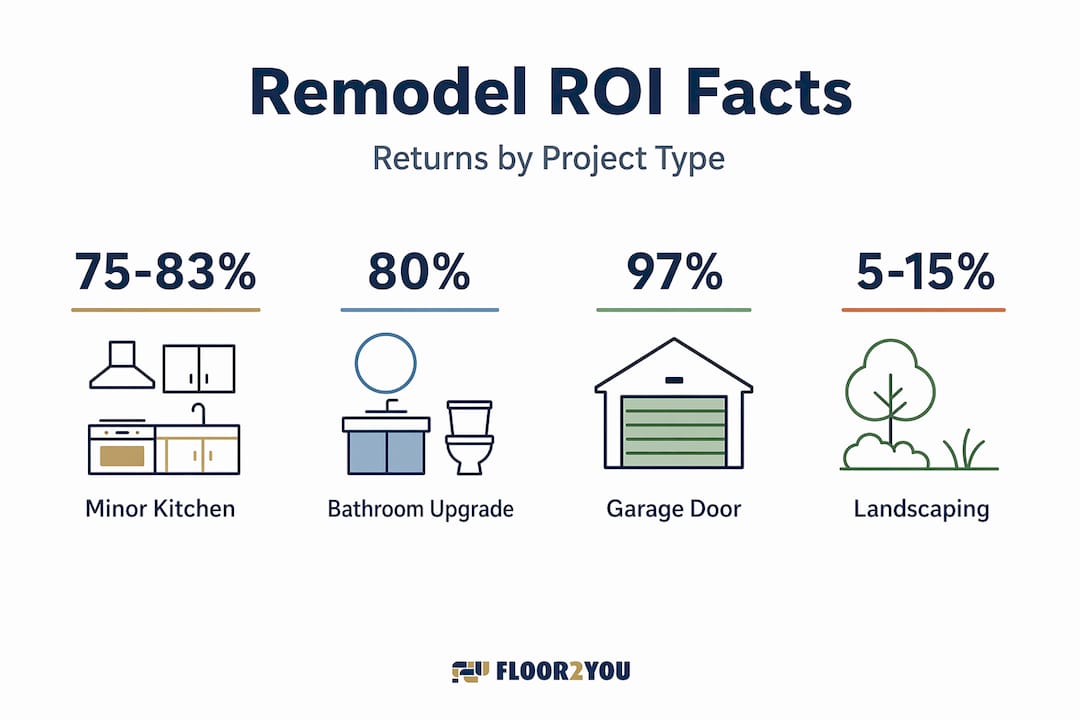
| Minor kitchen remodel | $26,000–$28,000 | $21,000–$23,000 | 75%–83% |
| Major upscale kitchen remodel | $80,000–$160,000 | $25,000–$83,000 | 31%–52% |
| Midrange bathroom remodel | $26,138 | $20,910 | ~80% |
| Upscale bathroom remodel | $75,000+ | ~$31,500 | ~42% |
| Garage door replacement | $4,500 | $12,500 | ~268% |
| Steel entry door | $2,400 | $5,200 | ~216% |
Minor kitchen remodels recoup 75% to 83% of their cost, while major upscale kitchen remodels return only 31% to 52%. You can explore the full breakdown of kitchen, bath, and flooring renovation types and see which scope levels make financial sense before committing to a major gut job.
Midrange bathroom remodels run about $26,000 and return close to 80% ROI. The upscale version of the same remodel costs three times as much and returns roughly 42%. The bathroom you want is not always the bathroom the market will reward.
Energy-efficient upgrades: the quiet overperformers
Energy efficiency improvements are underrated in most remodeling conversations. Heat pump conversions can deliver over 103% ROI, and attic insulation saves 15% to 25% on heating and cooling costs while returning 80% to 100% or more at resale. In South Florida's climate, energy efficiency is not a luxury. It is a selling point buyers actively seek out.
Pro Tip: Pair energy upgrades with cosmetic improvements. A new HVAC system with updated flooring and fresh paint creates a home that feels new from the first walkthrough and the first utility bill.
Why your home's current value sets the rules
This is the concept most homeowners skip, and it is also the one that generates the most regret. Remodeling decisions should always be anchored to what your home is currently worth in its current market.
Here is a practical framework to guide your planning:
-
Find your current market value. Pull recent comparable sales within a half-mile of your home. Your target remodel budget should stay proportional to that number, not to what you wish the home were worth.
-
Apply the 10% rule for single projects. Renovation budgets for a single project generally should not exceed 10% of your home's value. On a $350,000 home, that means capping a kitchen remodel around $35,000.
-
Watch the 30% ceiling for total renovations. Total renovation spend above roughly 30% of home value risks pushing your price above what comparable homes support. At that point, you have likely priced yourself out of your own neighborhood.
-
Consult a local real estate professional before you start. Over-spending on high-end finishes consistently leads to poor ROI. A quick conversation with someone who sells homes in your zip code is worth more than any design magazine.
-
Separate lifestyle spending from investment spending. Some upgrades are for you, and that is fine. A custom wine cellar might bring you joy but will not bring buyers to your door. Be honest with yourself about which category each project falls into.
The over-improvement trap is real, and it hits harder than most homeowners expect. Over-improvements return only about $0.40 to $0.50 per dollar spent. That means a $50,000 over-improvement might add $20,000 to $25,000 in actual value. You are paying full price to give future buyers a discount.
Pro Tip: Check your neighborhood's price range before finalizing a scope of work. If the top-selling homes in your area are at $450,000, a remodel budget designed to create a $600,000 home is a financial decision that the local market will not support.
Planning your remodel with value in mind
Good remodeling decisions are not made at the showroom. They are made before you ever walk in.
Start by understanding what buyers in your specific market are looking for. Strategic remodeling requires alignment between design choices, your home's architecture, and real estate market data. What sells well in one zip code may be irrelevant in another. In South Florida, buyers often prioritize updated flooring, modern kitchens, and outdoor living space over features that would top wish lists in colder climates.
When sequencing your projects, start with curb appeal. First impressions set buyer expectations for every room that follows. A stunning kitchen means less if buyers arrive skeptical before they open the front door. Work from outside in and from structural to cosmetic.
Use these practical approaches to keep value at the center of your planning:
- Pull a comparative market analysis from a local agent to understand your neighborhood's price ceiling before you commit to a scope.
- Prioritize projects with the strongest cost-to-value payback based on current data, not five-year-old renovation advice.
- Keep finishes in the midrange category unless your neighborhood consistently supports luxury-tier home prices.
- Focus on broad appeal. Neutral colors, clean lines, and functional layouts attract more buyers than bold design choices.
- Avoid ultra-personalized features that appeal to a narrow slice of buyers, such as themed rooms, exotic materials, or highly specific layouts.
You can also read more about remodeling costs and value to understand how local experts approach project budgeting and priority-setting in the South Florida market.
Pro Tip: If you plan to sell within three to five years, prioritize projects that buyers can see and feel immediately during a showing: flooring, paint, kitchen surfaces, and bathroom fixtures. These create emotional appeal and support your asking price.
My honest take on remodeling economics
I have seen this play out dozens of times. A homeowner falls in love with a design idea, commits to a budget that feels manageable in the moment, and ends up with a beautifully renovated home that sits on the market for weeks because the price outpaces the neighborhood.
In my experience, the biggest mistake homeowners make is treating remodeling like a guaranteed investment rather than a conditional one. The return is only there if the project matches what local buyers actually want, at a price point the market can support.
What I find counterintuitive, and what the data backs up, is that buyers primarily want clean, functional, and updated homes. Not showcases. Not custom luxury finishes. The homeowner who refreshes flooring, updates fixtures, and repaints throughout often outperforms the one who installed a chef's kitchen that buyers cannot afford to price in.
The lesson I keep coming back to is simple: your home's current value tells you what the market has already decided about your street, your neighborhood, and your price range. Remodeling should work with that number, not against it. When you stop trying to outspend your market and start trying to optimize within it, the ROI math starts working in your favor.
— G
Ready to remodel smarter with Floor2you?
Understanding the financial side of remodeling is step one. Step two is working with a team that brings both craftsmanship and market awareness to every project.

Floor2you specializes in residential remodeling and flooring installation across South Florida, covering kitchen and bathroom remodels, hardwood, vinyl, laminate, and tile flooring, plus professional painting services. Every project is managed with a focus on quality that holds up at appraisal, not just on Instagram. Whether you are preparing a home for resale or investing in a long-term upgrade, Floor2you helps you prioritize the right projects at the right scope. Get in touch for a personalized quote and find out which improvements will make the most financial sense for your specific home and neighborhood. Visit Floor2you to get started today.
FAQ
Why should you consider home value before starting a remodel?
Your home's current market value sets the realistic ceiling for what any renovation can return at resale. Spending beyond what comparable homes in your area support often means recovering far less than you invested.
Which remodeling projects add the most value?
Garage door replacement, steel entry doors, minor kitchen remodels, and midrange bathroom updates consistently deliver the highest ROI, often returning 75% to 268% of their project cost in added resale value.
What is over-improvement and how do you avoid it?
Over-improvement happens when you spend beyond what your local market will support, leaving upgrades that buyers cannot price into a competitive offer. Keep single projects under 10% of your home's current value and total renovation budgets under 30% to stay within market range.
How do energy-efficient upgrades affect home price?
Energy-efficient upgrades like heat pump installations and attic insulation can return 80% to over 100% of their cost at resale while also reducing monthly utility bills, making them strong investments in most markets.
Should you hire a real estate agent before remodeling?
Yes. A local agent can provide current comparable sales data and tell you which upgrades buyers in your specific market prioritize, helping you allocate your budget to projects that actually move the needle at sale.