

TL;DR:
- Turnkey remodeling is a comprehensive process managed by one firm from design through installation, delivering a move-in ready space. It consolidates all coordination, scheduling, and accountability, reducing homeowner stress and project duration, especially beneficial in South Florida's complex market. The success of turnkey projects depends on clear scope contracts, experienced firms, and early homeowner decisions, with thorough vetting to prevent unexpected costs.
Turnkey remodeling is defined as a full-service renovation model where one firm manages every phase of the project, from initial design through final installation, delivering a move-in ready result. Unlike hiring separate contractors for plumbing, flooring, and cabinetry, turnkey places all coordination, scheduling, and accountability under a single team. Firms like Kern & Co and Venue Construction Group describe this as the client simply "turning the key" and walking into a finished space. For busy homeowners and property investors in South Florida, that single-source structure is the core appeal.
What is turnkey remodeling and how does it work?
Turnkey remodeling means one firm manages the full renovation process, integrating design, procurement, construction, and the final walkthrough under one dedicated team. The homeowner does not source subcontractors, chase permits, or mediate disputes between a tile installer and a plumber. That burden shifts entirely to the firm.

The phrase "turnkey" comes from construction industry shorthand for delivering a completed, ready-to-use project. As Venue Construction Group explains, the client should be able to simply turn the key and move in, with upfront clarity on what "ready" actually means before a single wall is touched.
This model is especially relevant for the South Florida renovation market, where juggling multiple licensed contractors across different trade categories adds weeks of coordination time. A single point of contact eliminates that friction entirely.
How turnkey differs from traditional remodeling
The biggest practical difference between the two models is where accountability lives. In traditional remodeling, the homeowner acts as the de facto project manager. You hire a general contractor, a separate designer, an independent tile installer, and a flooring company. When the tile delivery is late and it delays the flooring crew, that scheduling conflict lands in your inbox.
Turnkey places accountability and coordination under one firm. If a subcontractor falls behind, the turnkey firm resolves it internally without pulling the homeowner into the dispute. That structural difference changes the entire experience.
| Factor | Traditional remodeling | Turnkey remodeling |
|---|---|---|
| Project management | Homeowner coordinates vendors | Single firm manages all trades |
| Accountability | Split across multiple contractors | One firm owns all outcomes |
| Scheduling | Sequential, gaps between phases | Overlapping phases reduce downtime |
| Communication | Multiple points of contact | One dedicated project manager |
| Stress level | High homeowner involvement | Minimal homeowner burden |
Beyond the table above, the design integrity difference matters. Kern & Co notes that turnkey teams maintain design integrity because the same team responsible for the design also executes it. There is no translation loss between a designer's vision and what a separate contractor actually builds.
- Traditional remodeling requires homeowners to vet and schedule each trade independently
- Turnkey uses an integrated calendar that overlaps permitting, procurement, and construction phases
- Disputes between subcontractors are resolved by the firm, not escalated to the homeowner
- A single invoice and timeline simplify budgeting and planning
For property investors, this structure is particularly valuable. One timeline, one invoice, and centralized documentation make underwriting and resale planning far more manageable than piecing together records from five different contractors.
How the turnkey remodeling process works step by step
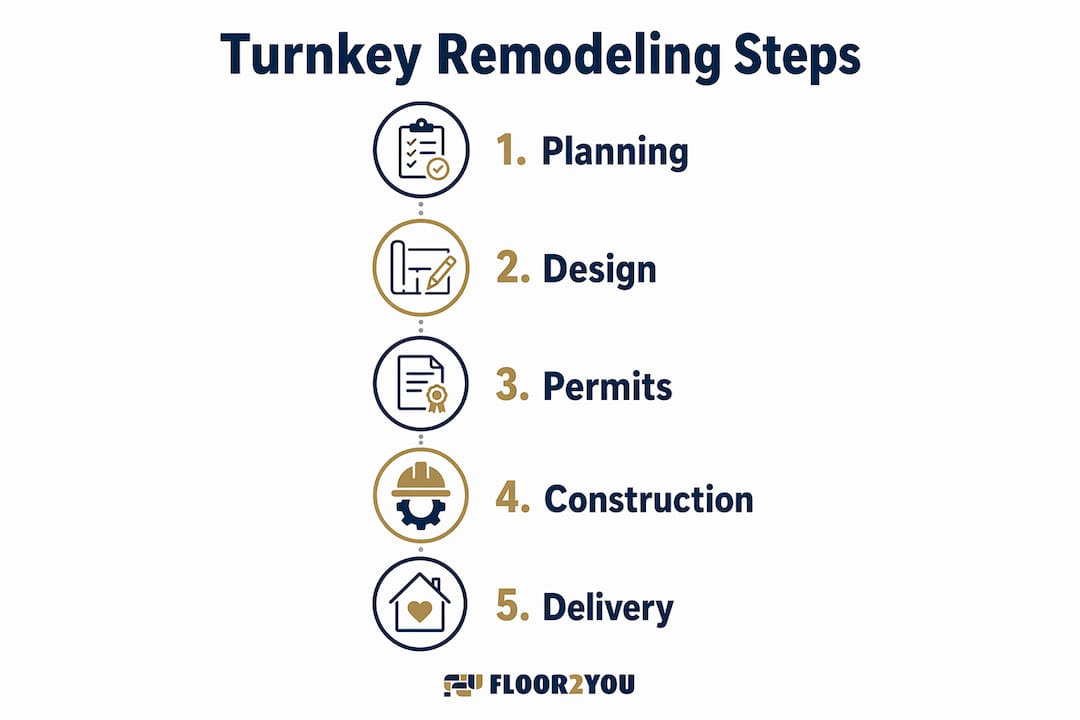
Understanding the workflow removes the mystery from what you are actually paying for. A well-run turnkey project follows a clear sequence, even if phases overlap.
- Initial consultation and scope definition. The firm meets with you to understand goals, budget, and timeline. This is where the project scope gets documented in writing, including every inclusion and exclusion.
- Design development. Architects, interior designers, and trade specialists collaborate under one roof. You review and approve selections before procurement begins.
- Permitting and procurement. The firm pulls all required permits and orders materials simultaneously. Overlapping these phases is one of the primary ways turnkey reduces total project time.
- Construction and trade coordination. A dedicated project manager oversees on-site work, supervises subcontractors, and maintains client communication. Kern & Co confirms that dedicated project managers handle permits, supervision, and updates without burdening the homeowner.
- Final walkthrough and delivery. The firm conducts a quality inspection before handing over the finished space. You walk through, confirm everything meets the agreed scope, and receive your move-in ready result.
Pro Tip: Lock in all material selections before construction starts. Late design decisions are one of the most common causes of mid-project delays, even in well-managed turnkey projects. Ask your firm for a formal decision schedule tied to procurement lead times.
The remodel project management discipline behind this workflow is what separates a smooth turnkey experience from a frustrating one. Firms that use integrated scheduling software and assign a named project manager to your job deliver measurably better outcomes than those that treat coordination as an afterthought.
What does a turnkey contract actually include?
This is where many homeowners get surprised. There is no universal definition of what "turnkey" covers. The scope depends entirely on what is written into your contract, and the variation is significant.
Some turnkey contracts cover the complete project from demolition through final styling, including furniture placement and decorative finishes. Others cover only design and construction management, leaving final finishes, appliances, or permit fees as the homeowner's responsibility. Kern & Co's research confirms that scope interpretations vary widely, and written contract specificity is the only protection against scope creep or unexpected costs.
Common inclusions to confirm in writing:
- Demolition and debris removal
- All labor and subcontractor fees
- Material procurement and delivery
- Permit applications and fees
- Final inspections and punch-list resolution
Common exclusions to watch for:
- Utility upgrades or rerouting
- Structural engineering fees
- Furniture, appliances, or decorative accessories
- Landscaping or exterior work
- HOA approval costs
Pro Tip: Before signing, ask the firm to walk you through every line item and explicitly state what is NOT included. A vague contract that says "complete renovation" without itemizing exclusions is a red flag. Get specifics in writing before work begins.
The contract clarity issue is especially important for investors managing multiple properties. A scope misunderstanding on one unit can cascade into budget overruns across an entire portfolio.
Benefits and key considerations of turnkey home improvement
The advantages of turnkey renovation are real and well-documented, but they come with conditions worth understanding before you commit.
Core benefits:
- Reduced stress. The hands-off experience means you are not managing daily logistics or fielding calls from subcontractors.
- Faster completion. Integrated scheduling and overlapping phases cut total project time compared to sequential traditional models.
- Budget certainty. Fixed-price contracts provide upfront cost clarity and shift most financial risk to the contractor.
- Single accountability. One firm owns all outcomes, which eliminates the finger-pointing common in multi-vendor projects.
- Design integrity. The same team that designs the space builds it, preserving the original vision through execution.
For property investors specifically, turnkey renovation supports faster occupancy timelines and produces the centralized documentation that lenders and appraisers require. Venue Construction Group notes that investors should verify how contractors handle unknown site conditions and confirm that appraisal-ready documentation is part of the deliverable.
Key considerations before signing:
- Verify the firm's license, insurance, and portfolio of completed projects in your property type.
- Confirm the change-order policy in writing. Successful turnkey projects depend on change-order control and early specification decisions to prevent mid-project cost escalation.
- Ask how unknown site conditions are handled. Discovering outdated wiring or water damage mid-project can trigger costs not covered by a fixed-price contract.
- Request references from past clients with similar project scopes, not just showcase photos.
Pro Tip: For investors, ask the firm to provide a project summary document at completion that includes permit records, material specifications, and warranty information. This package directly supports appraisal and future resale conversations.
Hiring a qualified remodeling contractor with a proven turnkey track record is the single most important decision in this process. The model only delivers its promised benefits when the firm executing it has the systems and experience to back it up.
Key takeaways
Turnkey remodeling delivers its full value only when the contract is specific, the firm is experienced, and the homeowner commits to early decisions that keep procurement and construction on schedule.
| Point | Details |
|---|---|
| Single-source management | One firm handles design, permitting, procurement, and construction under one contract. |
| Scope must be written | Inclusions and exclusions vary widely; a vague contract creates unexpected costs. |
| Faster project timelines | Overlapping phases like permitting and procurement reduce total project duration. |
| Fixed-price certainty | Upfront pricing shifts financial risk to the contractor, not the homeowner. |
| Investor documentation | Request permit records, specs, and warranties at completion to support appraisal and resale. |
Why I think most homeowners underestimate the contract
Most people researching turnkey remodeling focus on the convenience angle, and that is fair. The hands-off experience is genuinely appealing. But after seeing how these projects play out, the contract is where the real story lives.
I have watched homeowners sign agreements that said "full renovation" and later discover that permit fees, appliance installation, and final touch-up painting were all excluded. The firm was not being dishonest. The contract was just vague, and both parties filled in the gaps with different assumptions.
The firms that execute turnkey well, like those following the Kern & Co model, treat the scope document as a living agreement that gets reviewed and confirmed before each phase. That discipline is what separates a genuinely stress-free experience from one that turns contentious at the final invoice.
My honest advice: spend more time on the contract than on the design selections. The tile color can be changed. A poorly written exclusion clause cannot be undone once construction is underway. Ask hard questions before you sign, and treat any firm that resists specificity as a warning sign worth taking seriously.
— G
Ready to simplify your next renovation with Floor2you?
Floor2you brings the turnkey remodeling model to South Florida homeowners and property investors who want expert results without the coordination headache.

Floor2you manages the full project from initial design through final installation, covering kitchen remodels, bathroom renovations, flooring in hardwood, vinyl, laminate, and tile, and professional painting. One team, one timeline, and a finished space you can walk into with confidence. Whether you are upgrading a primary residence or turning over a rental property, Floor2you delivers the craftsmanship and project oversight that makes the process work. Start your project with a team that handles every detail from day one.
FAQ
What does turnkey mean in a remodeling contract?
Turnkey means one firm manages the entire renovation from design through final delivery, providing a move-in ready result. The exact scope depends on the contract, so always confirm inclusions and exclusions in writing before signing.
How is turnkey remodeling different from hiring a general contractor?
A general contractor typically manages construction only, while a turnkey firm also handles design, procurement, permitting, and final finishing under one agreement. The key difference is that turnkey consolidates all accountability and communication into a single point of contact.
Is turnkey remodeling more expensive than traditional remodeling?
Turnkey projects often carry a higher upfront price because the firm absorbs coordination costs and risk. However, fixed-price contracts provide budget certainty that traditional multi-vendor projects rarely offer, and faster timelines reduce carrying costs for investors.
What should I verify before hiring a turnkey remodeling firm?
Confirm the firm's license, insurance, change-order policy, and how they handle unknown site conditions. Ask for a written scope document that itemizes every inclusion and exclusion before any work begins.
Is turnkey renovation a good option for rental property investors?
Yes. Turnkey renovation gives investors centralized documentation, a single timeline, and faster occupancy, all of which support appraisal and resale planning. Verify that the firm provides permit records and material specifications at project completion.