
TL;DR:
- Choosing a thicker floor does not guarantee better soundproofing; material density and installation quality are more important. Soundproof flooring reduces impact and airborne noise but is never completely noise-proof, especially due to flanking sound transmission. Proper subfloor preparation, moisture barriers, and selecting the right system for your specific environment are essential for effective noise reduction in South Florida homes.
Many South Florida homeowners assume that choosing a thicker floor automatically means a quieter home. It's an understandable assumption, but it's mostly wrong. The reality is that noise reduction in your floors depends on a mix of material density, underlayment quality, and installation technique, none of which are guaranteed just because a plank is thick. Whether you're dealing with noisy upstairs neighbors, children running across the second floor, or the constant hum of street traffic, understanding how soundproof flooring actually works can save you money and prevent costly mistakes before your next renovation begins.
Table of Contents
- What does soundproof flooring really mean?
- Types of soundproof flooring and their effectiveness
- What actually matters: Thickness, density, and real-world performance
- How to select and install soundproof flooring in your home
- The real truth about soundproof flooring: Beyond the buzzwords
- Get expert help with soundproof flooring in South Florida
- Frequently asked questions
Key Takeaways
| Point | Details |
|---|---|
| Density beats thickness | Choose dense and stiff flooring for better soundproofing rather than relying on thickness alone. |
| Local climate matters | Select flooring and underlayment that handle South Florida's humidity as well as noise. |
| Installation is critical | Proper installation with the right materials ensures the flooring performs as promised. |
| Customize for your home | Evaluate room use, location, and personal preferences instead of following generic advice. |
What does soundproof flooring really mean?
Soundproof flooring is any flooring system designed to reduce the transfer of sound, either into a room from outside or between the floors of a multi-story home. The term "soundproof" is actually a bit misleading. No floor is truly 100% soundproof. What flooring systems do is reduce sound transmission to a noticeable, livable degree.
To understand this properly, you need to know the difference between two types of noise:
- Airborne noise: Sound that travels through the air, like voices, music, or a TV. This type passes through walls and floors as sound waves.
- Impact noise: Sound created by direct physical contact with a surface, like footsteps, dropped objects, or furniture being dragged across a floor.
Most flooring products focus on reducing impact noise, because that's where floors play the biggest role. Airborne noise reduction typically requires improvements to walls, ceilings, and insulation, not just the floor.
One key measurement used in the flooring industry is the IIC rating, short for Impact Insulation Class. This number tells you how well a floor system blocks impact noise. A higher IIC score means better sound blocking. The standard minimum for multi-family housing in most building codes is an IIC of 50, but products used in quality residential projects often aim for 55 or higher.
"Thickness does not equal performance. According to ASTM E2179 testing, density and stiffness are the factors that actually determine how well a flooring system performs acoustically."
This matters because many homeowners pick a thick laminate or vinyl plank, expecting silence, and end up disappointed. Thickness contributes slightly, but a dense, properly installed product with quality underlayment will almost always outperform a thick, lightweight one. One more thing worth noting: in humid climates like South Florida, moisture barriers in flooring are not optional. Moisture that seeps into your subfloor can warp underlayment, creating air gaps that actually make sound transmission worse over time.
Types of soundproof flooring and their effectiveness
There are several flooring types that offer varying levels of sound reduction. Understanding what each one does well, and where it falls short, helps you make a smart decision for your specific home.
Carpet is widely considered the most effective material for absorbing airborne and impact sound. Its soft, fibrous surface traps sound waves and cushions impact. However, in South Florida's humid climate, carpet can absorb moisture and become a breeding ground for mold and dust mites. It also shows wear faster in high-traffic areas like hallways and living rooms. While carpet is rated best for acoustic absorption in controlled conditions, hard floors with the right underlayment are generally more practical for moisture-prone coastal homes.
Cork flooring is a surprisingly strong performer. Its natural cellular structure absorbs both impact and airborne sound effectively. It also resists moisture better than carpet and has natural antimicrobial properties. The downside is that cork can dent under heavy furniture and may need periodic resealing in very humid environments.
Rubber flooring offers excellent impact noise reduction and is nearly impervious to moisture. It's most common in gyms, utility rooms, and commercial spaces, but high-quality rubber tiles are increasingly used in residential applications where durability and noise control are priorities.
Engineered vinyl plank (EVP) with an attached foam or cork underlayment is currently one of the most popular options for South Florida homeowners. It looks like hardwood, resists moisture, and the underlayment layer does meaningful work to dampen impact noise. Exploring best flooring types for South Florida can help you narrow down which version of EVP or waterproof flooring options will hold up best in your specific rooms.
Laminate with underlayment can also perform well if the right underlayment is selected separately, since some laminate products come with a thin foam pre-attached that barely makes a difference. Adding a thicker, denser cork or foam underlayment underneath laminate noticeably improves its IIC rating.
| Flooring type | Soundproofing effectiveness | Moisture resistance | South Florida suitability |
|---|---|---|---|
| Carpet | Excellent | Poor | Low (humidity concerns) |
| Cork | Good | Moderate | Moderate |
| Rubber | Excellent | Excellent | High |
| Engineered vinyl plank | Good to very good | Excellent | Very high |
| Laminate with underlayment | Moderate to good | Fair | Moderate |
| Hardwood | Poor alone | Poor | Low without treatment |
Pro Tip: When shopping for engineered vinyl plank in South Florida, look for products rated for "below-grade" or "on-grade" installation with a built-in underlayment of at least 1.5mm cork or foam. This baseline gives you practical noise reduction without the moisture risk of carpet.
What actually matters: Thickness, density, and real-world performance
Here's where things get technical, but stay with us because this section will save you from wasting money on a flooring product that underdelivers.
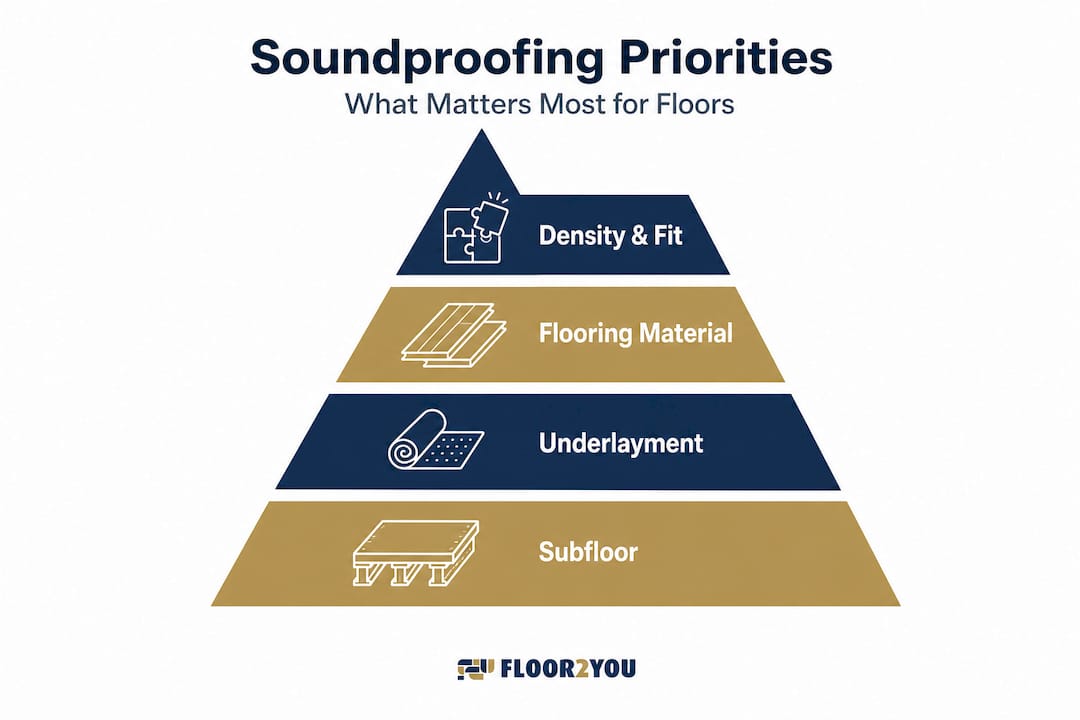
Thickness is visible and easy to measure at a showroom. Density is not. But density, and specifically how stiff a material is, determines how well it resists the vibrations that carry sound. Think of it this way: a thick foam mattress absorbs some impact but still lets plenty of sound through because it lacks density. A dense rubber tile, even a thin one, blocks more impact noise because it is stiff enough to stop vibration at the source.
This is exactly what ASTM E2179 testing reveals. Lab tests measure a product's IIC under controlled conditions. In real-world homes, however, the performance is often 5 to 10 IIC points lower than what the label claims. The reason? A phenomenon called flanking. Flanking is when sound bypasses the floor itself and travels through walls, baseboards, joists, or pipes connected to the structure. No floor, no matter how well rated in a lab, can block flanking noise on its own.
Key data point: A product rated IIC 60 in a lab setting may only perform at IIC 50 to 55 in your actual home due to flanking transmission paths.
| Test condition | Typical IIC rating |
|---|---|
| Lab (controlled, no flanking) | 58 to 65 |
| Field (real home, with flanking) | 50 to 57 |
| Field with poor subfloor or gaps | Below 50 |
Investing in quality flooring's impact on your home's comfort and value is about more than just what the spec sheet says. The practical takeaway here is to choose products that have been tested in real-world field conditions, not just lab conditions. Ask your supplier for the FIIC (Field Impact Insulation Class) rating, not just the lab IIC. And when possible, seal baseboards and fill gaps around pipes where flanking can sneak through.
Pro Tip: Before your installer lays a single plank, walk the subfloor and listen for squeaks or soft spots. These signal gaps or damage that will undermine any soundproofing product you install on top. A well-prepared subfloor is the single biggest factor in getting real-world performance close to lab performance.
How to select and install soundproof flooring in your home
Choosing the right soundproof flooring for your South Florida home is not just about picking the highest IIC number. It's about matching the right product to your specific rooms, your budget, and the realities of living in a warm, humid coastal climate.
Here's a practical process to follow:
- Identify the noise problem first. Is it footsteps from above? Street noise? Voices from a shared wall? This tells you whether impact noise or airborne noise is your primary issue, which guides your product choice.
- Assess each room's moisture exposure. Bathrooms, kitchens, and rooms near exterior walls in South Florida face higher humidity. Choose moisture-resistant materials like EVP or rubber for these areas, and avoid carpet or cork without proper sealant.
- Set a realistic budget. Quality underlayment often costs less than upgrading to a premium flooring product. Sometimes spending $0.50 more per square foot on underlayment delivers more sound reduction than spending $2.00 more per square foot on fancier planks.
- Check local building codes. Multi-family homes and condos in Florida often have specific IIC requirements. Know what your building requires before you buy.
- Work with a flooring professional. A local expert who knows South Florida construction styles, common subfloor types, and regional humidity levels will help you avoid the common traps that turn a promising floor into a noise problem.
Using a flooring installation checklist before your project starts ensures nothing gets overlooked, from moisture testing the subfloor to verifying underlayment coverage at the edges. And if you're thinking about how your floor choices affect the look and feel of your entire home, exploring flooring design for South Florida homes can tie the functional and aesthetic decisions together.
Before hiring any installer, ask these three questions: What is the field-tested IIC rating for this product? How do you handle subfloor prep? And what underlayment are you recommending, and why?
Hard floor paired with proper underlayment consistently outperforms carpet in long-term moisture environments. This is a critical distinction for South Florida homeowners who want performance that lasts years, not just a few seasons.
Pro Tip: Always ask your installer to run the underlayment a few inches up the wall before trimming and installing baseboards. This helps close one of the most common flanking paths in residential installs.
The real truth about soundproof flooring: Beyond the buzzwords
Here's our honest take after working with hundreds of South Florida homeowners on flooring projects: the flooring industry does a good job of confusing buyers with impressive-sounding specifications and oversimplified claims. The word "soundproof" itself is marketing language. Nothing is soundproof.
What we see regularly is homeowners who buy based on IIC lab ratings, expecting the same result in their home, and then feel let down when their finished floor still lets through footstep noise from upstairs. The gap between lab ratings and real-world IIC performance is real and predictable. Density and stiffness matter, flanking paths matter, and the condition of your subfloor matters more than almost any product spec on the market.
The bigger issue we've noticed is that South Florida homes have unique needs that most flooring guides completely ignore. Humidity swings, salt air near the coast, homes built on concrete slabs rather than wood frame construction. All of these affect how sound travels and how flooring products perform over time. A cork underlayment that performs brilliantly in a Denver home might degrade faster in a Miami condo if moisture barriers are not properly installed.
Our honest advice: stop chasing the highest IIC number and start thinking about the whole system. The floor, the underlayment, the subfloor, the moisture barrier, the baseboards, and even the furniture layout all play a role. Investing in flooring's value and comfort means making decisions that serve your actual life in your actual home, not a lab environment somewhere in Minnesota. Customizing your approach based on local conditions is not extra work. It's the only way to get results that actually hold up.
Get expert help with soundproof flooring in South Florida
Sorting through IIC ratings, underlayment options, and moisture considerations on your own is a lot. But you don't have to figure it all out before making a move.

At Floor2You, we work with South Florida homeowners every day to match the right flooring solution to their specific home, budget, and comfort goals. Whether you're upgrading a condo to reduce footstep noise, replacing carpet in a humid bedroom, or doing a full-floor renovation, our team brings real local expertise to every project. We handle everything from subfloor preparation to final installation, and we're upfront about what will actually perform in your climate. Reach out for a consultation and let's build a quieter, more comfortable home together.
Frequently asked questions
Does soundproof flooring work for second floors and condos?
Yes, soundproof flooring significantly reduces impact noise transmission between floors, making it especially valuable in multi-story homes and condos where foot traffic noise is a daily issue. Choosing a product with a high field-tested IIC rating gives you the most realistic performance estimate for your actual living space.
Can you add soundproofing to existing floors without replacing them?
You can add area rugs, acoustic mats, or even floating underlayment in some cases, but the most reliable noise reduction comes from installing new flooring with proper underlayment from the ground up. Partial solutions help, but they rarely close the gap on serious impact noise issues.
Is carpet always the best choice for soundproofing?
Carpet absorbs sound effectively in lab conditions, but in South Florida's humid environment it carries real risks related to moisture, mold, and faster wear in high-traffic areas. Hard floors with quality underlayment are often a more practical and longer-lasting choice for local homeowners.
What does IIC mean when comparing flooring for soundproofing?
IIC stands for Impact Insulation Class, a standardized rating that measures how effectively a floor system blocks impact noise like footsteps and dropped objects. Keep in mind that field IIC ratings are typically 5 to 10 points lower than lab ratings due to real-world variables like flanking.
Do I need a moisture barrier with soundproof flooring in South Florida?
Absolutely. South Florida's heat and humidity make moisture barriers essential for protecting both your soundproofing underlayment and your subfloor from water damage that would otherwise degrade your floor's performance over time. Skipping this step is one of the most common and costly mistakes local homeowners make.