

TL;DR:
- Seamless flooring creates continuous surfaces without visible joints, enhancing space flow and safety. True systems are poured, while near-seamless options use tight-locking planks or tiles for flexibility and lower costs. Proper planning and skilled installation are essential for durable, safe, and stylish transitions in residential designs.
Most homeowners assume that moving from one floor material to another means installing a visible metal or plastic strip at the doorway. That assumption leads to designs that feel chopped up and dated. A seamless flooring transition is the opposite of that. It connects two surfaces, or covers an entire floor, with no visible break, no raised edge, and no interruption to the flow of the space. Understanding what this means, which materials make it possible, and how to plan for it correctly will change the way you approach your next flooring project.
Table of Contents
- Key Takeaways
- What is seamless flooring transition: types and key characteristics
- Benefits of seamless flooring in residential spaces
- How to plan and install seamless flooring transitions
- Seamless floor design ideas for modern homes
- My take on true vs. near-seamless flooring
- Get expert help from Floor2you
- FAQ
Key Takeaways
| Point | Details |
|---|---|
| True vs. near-seamless | True seamless floors use poured materials; near-seamless options use tight-locking planks or tiles. |
| Maintenance advantage | Floors without joints cut deep cleaning time and costs by up to 30%. |
| Safety and compliance | Seamless transitions reduce trip hazards and must meet ADA height and slope guidelines. |
| Plan before you install | Early coordination prevents finish mismatches, slope errors, and voided warranties. |
| Design flexibility | Near-seamless materials offer more adaptability and lower cost than poured floors. |
What is seamless flooring transition: types and key characteristics
A seamless flooring transition refers to the way two floor surfaces meet, or the way a single floor system covers a space, without visible joints, gaps, or raised molding strips. The goal is a continuous visual and physical surface that does not interrupt movement, sight lines, or design intent.
There are two distinct categories worth understanding:
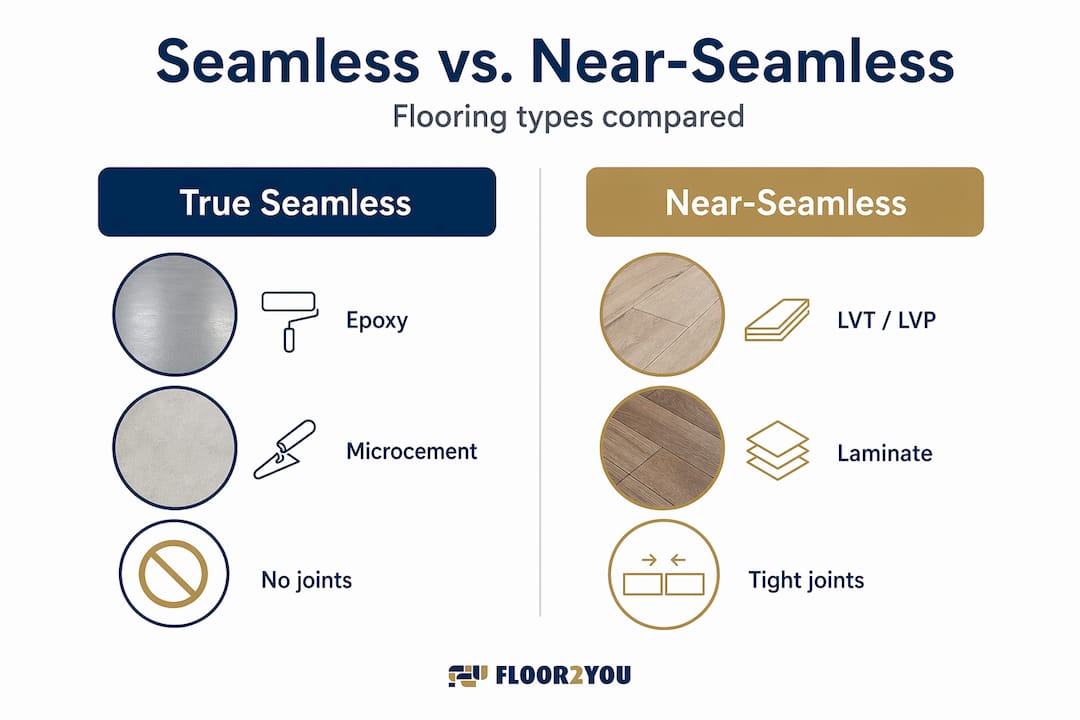
- True seamless floors are monolithic poured materials applied as a liquid or paste that cures into one continuous surface. Poured epoxy, microcement, and polished concrete fall into this group. There are no seams because the material is one piece.
- Near-seamless floors are manufactured planks or tiles, such as luxury vinyl tile (LVT), luxury vinyl plank (LVP), and laminate, that use precision-engineered locking systems to create joints so tight they are nearly invisible. The distinction matters: true vs near-seamless flooring is not just about looks. It affects cost, installation complexity, and how adaptable the floor is later.
- Flooring transition details refer specifically to the technical design of how two different floor surfaces meet at a threshold. This is a term architects and contractors use when documenting the exact method, material, and height management at a transition point.
- Microcement deserves special mention. It is applied in thin layers over existing floors, walls, or counters, and it bonds without expansion gaps. This makes it one of the most versatile true seamless options in residential renovations right now.
Pro Tip: When choosing between true and near-seamless options, ask your installer to show you a physical sample of the joint. What looks tight in a catalog photo often looks very different at your feet.
| Feature | True seamless (epoxy/microcement) | Near-seamless (LVT/LVP/laminate) |
|---|---|---|
| Visible joints | None | Minimal (nearly invisible) |
| Installation complexity | High, requires skilled applicators | Moderate, faster installation |
| Cost | Higher upfront | More budget-friendly |
| Replaceability | Difficult once poured | Individual planks replaceable |
| Best for | Bathrooms, open-plan living, wet areas | Bedrooms, living rooms, multi-room layouts |
Benefits of seamless flooring in residential spaces
The appeal of seamless flooring is not just visual. It solves real problems that traditional jointed floors create over time.
The most immediate benefit is how the space looks and feels. When floors flow from room to room without a metal strip interrupting the eye, rooms appear larger and more connected. Open-plan homes in particular gain enormously from this. The living room does not end abruptly at the kitchen. The space reads as one cohesive environment.
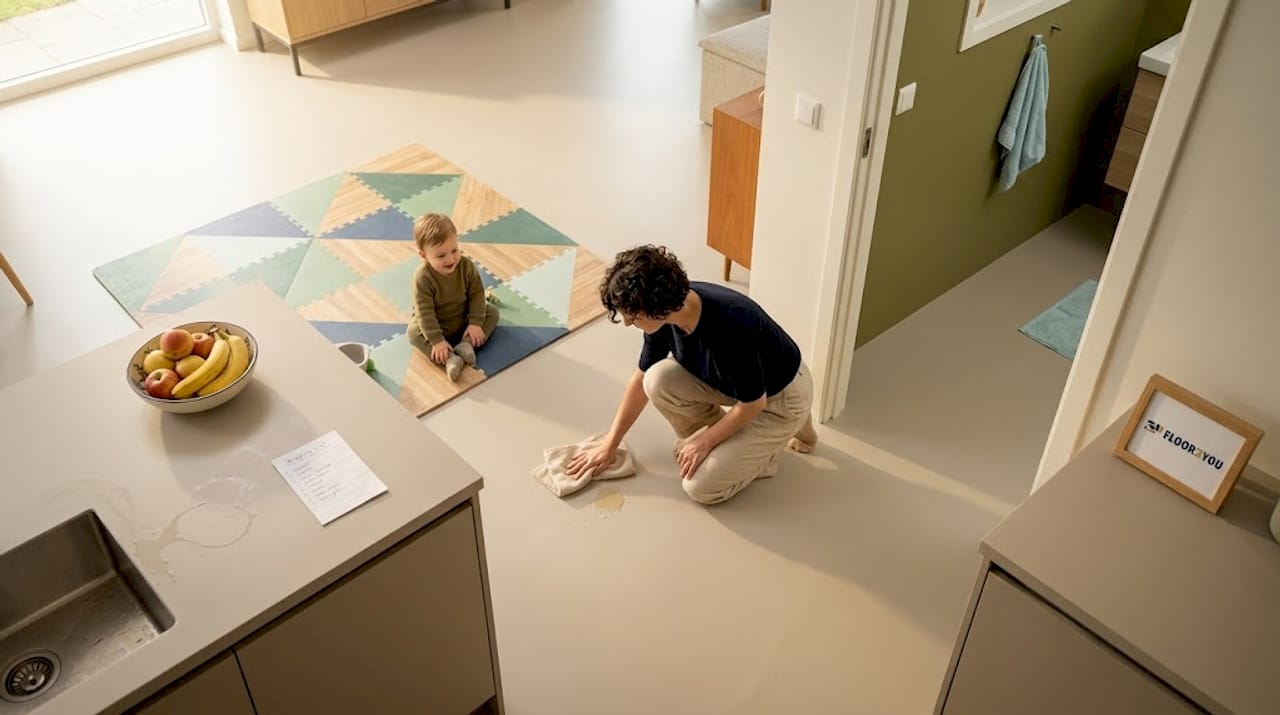
Maintenance is a serious practical advantage. Deep cleaning time drops by up to 30% when there are no joints, grout lines, or edge strips to scrub. Grout lines in tile floors trap dirt, mold, and bacteria at a rate that smooth surfaces simply do not. For South Florida homeowners dealing with humidity and frequent floor cleaning, this is not a minor point.
Durability is another factor worth taking seriously. Epoxy flooring lasts 10 to 20 years in residential settings with routine cleaning. Microcement and polished concrete perform similarly. These are not floors you replace every decade. You install them once and maintain them.
Safety is where seamless transitions perform better than most homeowners expect. Seamless transitions reduce trip hazards by eliminating the abrupt edges that traditional molding strips create. For households with young children, elderly residents, or anyone with mobility considerations, this matters more than aesthetics.
Homeowners increasingly prefer seamless flooring for minimalist aesthetics and easier upkeep compared to grout lines and plank joints. This preference is also showing up in home valuations. Buyers in the current market respond positively to open, clean floor plans with consistent flooring throughout. The investment pays back at resale. You can read more about how multi-surface flooring benefits property value if you want a deeper look at the financial case.
How to plan and install seamless flooring transitions
Getting a seamless transition right starts long before the first plank is laid or the first bucket of resin is mixed. Early planning prevents mismatched finishes, slope errors, and warranty issues that cost far more to fix than to avoid. Here is how to approach the process:
-
Map your floor heights early. Different flooring materials sit at different heights. Tile with a mortar bed sits higher than floating LVP. Hardwood sits higher than a thin microcement application. Before you select materials, document the finished height of each surface and how they will meet.
-
Understand ADA compliance thresholds. Even in private homes, these guidelines are the gold standard for safe transitions. ADA regulations require that vertical edges up to 1/4 inch are acceptable, edges between 1/4 and 1/2 inch must be beveled, and anything higher requires a formal ramp with slope limits. For residential accessibility, planning around these numbers protects everyone in the home.
-
Choose your transition method by room function. Wet areas like bathrooms need waterproof materials with zero joint penetration. High-traffic areas like hallways need abrasion resistance. Low-traffic bedrooms can prioritize softness and warmth. The transition detail should serve the specific conditions of each room.
-
Hire for the specific material. True seamless floors require applicators with hands-on experience in that system. A great tile setter is not automatically qualified to apply microcement. Ask for project photos from previous installs, not just references.
-
Account for expansion. Near-seamless floors still expand and contract with temperature and humidity. South Florida homes experience significant swings in both. Your installer should plan for this without creating visible gaps later.
Pro Tip: Ask your contractor to provide the manufacturer's installation specification sheet for whatever seamless or near-seamless product you choose. If they cannot produce it, that is a warning sign.
Poor transition planning is one of the most common causes of voided warranties and long-term safety problems. Unsupported edges crack. Improper slopes create water pooling. These are not hypothetical risks. They show up two years after installation when fixing them requires tearing out finished work. The flooring installation checklist from Floor2you is a useful resource for keeping your project on track.
Seamless floor design ideas for modern homes
One of the more underused design moves in residential spaces is using seamless flooring to erase the boundary between indoors and outdoors. In South Florida homes with sliding glass walls, extending a microcement or large-format porcelain floor from the living room through to the patio makes both spaces feel twice as large. The eye does not stop at the threshold.
Here are approaches that work well in practice:
- Single material throughout open plans. Using one LVP product from the front door through the kitchen and living area creates a clean, modern look without any design effort. The continuity does the work.
- Tone matching across different materials. If you want tile in the bathroom and LVP in the hallway, match the color tone closely so the transition reads as intentional contrast rather than an accident. Warm gray tile meeting warm gray LVP almost disappears at the threshold.
- Mixing textures within the same color family. A matte microcement floor in the kitchen meeting a slightly textured LVP in the living room creates tactile interest without visual chaos. This is a technique designers use frequently in high-end residential projects.
- Using grout-free large-format tile. Rectified tiles installed with near-invisible joints achieve a near-seamless look at a lower cost than poured systems, and they perform exceptionally well in bathrooms and kitchens.
"The best floor transitions are the ones you never notice. The goal is for guests to feel the space, not analyze it."
Kitchens and bathrooms are where seamless flooring pays the biggest design dividend. Both rooms deal with moisture, cleaning frequency, and the need for visual calm. A continuous microcement surface from floor to wall in a bathroom creates a spa-like environment that grout lines and tile edges simply cannot replicate. For kitchens, a sealed concrete or epoxy floor handles spills, resists stains, and wipes clean in seconds. The modern flooring trends for 2026 show a clear move toward cleaner, uninterrupted surfaces in exactly these spaces.
My take on true vs. near-seamless flooring
I've worked alongside enough remodeling projects to say this clearly: most homeowners do not need a true seamless poured floor. They need a near-seamless one that is installed precisely.
True seamless systems are beautiful and they perform exceptionally, but they are permanent in a way that makes many people uncomfortable. Once epoxy or microcement is down, changing it is a full demolition project. If your tastes shift, or if you sell and the buyer has different preferences, you are not simply swapping planks. Near-seamless options offer flexibility and cost savings that poured floors cannot match.
What I've found is that the gap between a well-installed near-seamless LVP floor and a microcement floor is smaller than most people expect visually, and enormous when it comes to cost and adaptability. The trade-off is usually worth it for most residential applications. Where I do recommend true seamless systems without hesitation is in bathrooms, especially shower floors and wet rooms, where the waterproofing advantage is not just aesthetic. It is structural.
The bigger mistake I see is not choosing the wrong system. It is choosing any system without involving a skilled contractor early enough. The design decisions that affect transitions happen at the planning stage, not during installation.
— G
Get expert help from Floor2you
If you are planning a flooring project in South Florida and want transitions that look intentional and perform for years, Floor2you can help you get it right from the start.

Floor2you's team handles everything from material selection and subfloor preparation to precision installation across hardwood, vinyl, laminate, and tile. They work with homeowners and designers who want results that hold up to South Florida's climate, high-traffic use, and the demands of rental and resale markets. Getting the transition detail right is not guesswork when you have experienced hands managing the project. Explore Floor2you's flooring services to see how they can take your project from concept to completion with the quality and speed South Florida homeowners expect.
FAQ
What is a seamless flooring transition?
A seamless flooring transition is where two floor surfaces meet without a visible raised strip, or where a single floor material covers an entire space without joints. The result is a smooth, continuous surface that improves both safety and aesthetics.
What materials are used for true seamless floors?
True seamless floors use poured or applied materials such as epoxy resin, microcement, and polished concrete. These systems cure into one continuous surface with no seams or joints at all.
How do near-seamless floors differ from true seamless floors?
Near-seamless floors use precision-manufactured planks or tiles, such as LVT or LVP, with locking joints so tight they appear invisible. They look very similar to true seamless floors but cost less and are easier to replace.
Are seamless flooring transitions required to meet ADA standards?
ADA guidelines specify that vertical edges up to 1/4 inch are allowed, edges between 1/4 and 1/2 inch must be beveled, and taller differences require a ramp. These standards apply to residential spaces where accessibility is a priority.
How long does seamless flooring last in a home?
Properly installed epoxy flooring lasts 10 to 20 years in residential settings with basic cleaning. Microcement and polished concrete perform at a similar level with routine maintenance.