

TL;DR:
- Home renovation planning often exceeds construction time, especially in South Florida due to permits and inspections. Proper sequencing, detailed scope definitions, and early permit applications keep projects on schedule and within budget. Working with experienced contractors familiar with local regulations minimizes delays and ensures successful project completion.
Most homeowners assume renovation projects are mostly about construction. In reality, planning often takes longer than the build itself, with kitchen projects averaging 9.5 months of planning before a single wall comes down. Understanding what is home renovation process means recognizing that construction is just one act in a much longer play. In South Florida specifically, permitting requirements, hurricane-rated material specs, and municipality-by-municipality inspection rules add layers that can stretch timelines significantly if you are not prepared from day one.
Table of Contents
- Understanding the home renovation stages
- Setting your renovation budget and scope with contingencies
- Navigating permits and inspections in South Florida renovations
- Managing lead times and inspections to keep your renovation on schedule
- Choosing and working with contractors for a smooth renovation
- Why most renovation delays stem from early-stage missteps and how to avoid them
- Get professional support for your South Florida home renovation
- Frequently asked questions
Understanding the home renovation stages
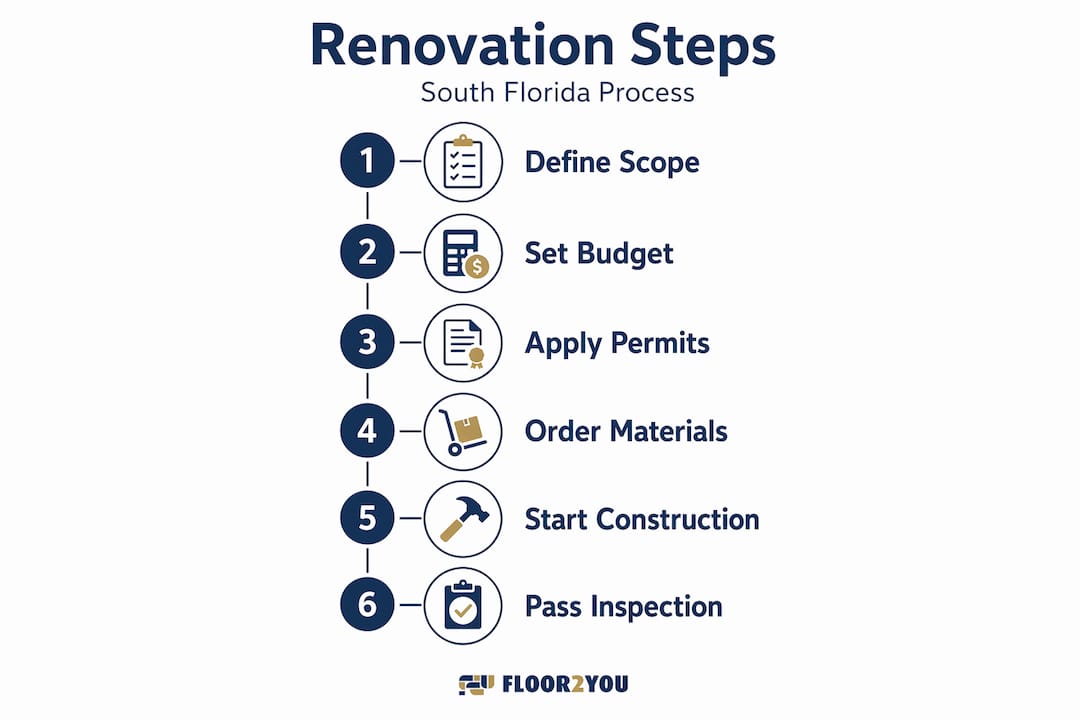
The home renovation process follows a predictable sequence, but each phase has its own complexity. Renovation stages include planning, permitting, procurement, construction, inspections, and a final punch list. Skipping or rushing any one of them creates problems in the next. Think of the phases as dominoes. Set them up correctly and the whole thing flows. Get one out of order and you spend weeks trying to recover.
Here is how the main home renovation steps break down:
- Phase 1: Planning (2 to 6 weeks or more). This covers goal setting, design finalization, and scope definition. Structural changes can push this phase to three months or longer. Defining renovation goals early is the single best way to reduce costly changes mid-project.
- Phase 2: Permits and approvals. Depends entirely on scope and your city's building department backlog. In South Florida, this can take 3 to 8 weeks on its own.
- Phase 3: Material procurement. Cabinets, tile, fixtures, and custom finishes need to be ordered before construction starts. Lead times run 2 to 10 weeks. Ordering late means your contractors are standing around waiting.
- Phase 4: Construction and inspections. The phase most people picture when they think "renovation." Rough-in inspections for plumbing and electrical happen mid-construction, not just at the end.
- Phase 5: Punch list and final walkthrough. Every unfinished item gets documented, corrected, and signed off. This is where quality is confirmed before final payment.
Understanding the full scope of types of home renovations you are planning, whether a full kitchen gut or a bathroom refresh, helps determine how many of these phases apply and how long each will take.
Pro Tip: If you are planning a home remodel in South Florida, start the permit application before your contractor mobilizes. Waiting until demo day to submit for permits is a guaranteed delay.
Setting your renovation budget and scope with contingencies
Budgeting is where most homeowners either protect themselves or leave themselves exposed. A common mistake is treating the contractor's bid as the total project cost. It is not. A realistic home improvement process budget has three buckets.
- Scope costs: Labor and materials as quoted in your contractor's bid.
- Permits and inspection fees: These vary by municipality and project type but can run several hundred to a few thousand dollars. Budget them separately so they do not catch you off guard.
- Contingency reserve: A 10 to 15 percent contingency on top of your scope cost is not optional. It is insurance against what demo reveals: water damage behind walls, outdated wiring that does not meet code, or structural surprises under the floor.
Budgeting separately for scope, permits, and contingency is how experienced homeowners avoid financial surprises. It also gives you clearer visibility into where money is actually going.
| Budget category | What it covers | Typical range |
|---|---|---|
| Scope (labor + materials) | All work in contractor's bid | Varies by project size |
| Permits and inspections | Building department fees | $300 to $2,500+ |
| Contingency reserve | Unexpected discoveries post-demo | 10% to 15% of scope cost |
| Material lead-time buffer | Delays from long-lead items | 5% to 10% of material costs |
Pro Tip: When researching home remodeling costs, ask your contractor for line-item pricing by trade, not a single lump sum. This gives you real control over scope cuts if needed.
South Florida's heat and humidity also factor into material choices. Some tile options perform far better here than others, and a quick look at tile renovation tips can save you from choosing materials that warp, crack, or absorb moisture in a tropical climate.

When hiring flooring contractors, always confirm they are familiar with South Florida's moisture conditions and subfloor requirements before you sign anything.
Navigating permits and inspections in South Florida renovations
Here is the reality that surprises most first-time renovators: permit rules in South Florida are not uniform. What requires a permit in Miami Gardens may be handled differently in Boynton Beach, Coral Springs, or Hialeah. Every municipality runs its own building department, processes applications at its own pace, and schedules inspectors on its own calendar.
For kitchens, structural and plumbing changes require a Residential Building Permit plus trade sub-permits, with four standard inspection stages in cities like Boynton Beach and Miami Gardens. That means your project will pause four times for inspectors before reaching completion.
For bathrooms, plumbing or electrical changes require permits, and waterproofing inspections, specifically shower pan flood tests, are essential because of South Florida's moisture exposure. Cosmetic work like painting, swapping fixtures, or replacing a toilet seat typically does not trigger a permit requirement. But always confirm with your local building department before assuming.
Common permit triggers in South Florida kitchen and bathroom renovations:
- Moving or adding plumbing supply or drain lines
- Adding or relocating electrical circuits or panel upgrades
- Removing or modifying load-bearing walls
- Installing range hoods with new ductwork penetrations
- Any work requiring changes to the structural envelope
What happens when an inspection fails? Re-inspection fees typically run $75 to $250 per visit, and your contractor cannot continue that phase of work until you pass. Common reasons for failure include incomplete appliance specs or unfinished hardware layouts during kitchen inspections. These are avoidable, but only if your contractor has done this before in South Florida specifically.
Reviewing bathroom remodeling permits and bathroom remodel trends together helps you understand which design upgrades will trigger permit requirements and which will not. Understanding the full inspection phases in renovations before you start keeps the schedule from unraveling mid-project.
| Work type | Permit required? | Key inspections |
|---|---|---|
| Cosmetic updates only | Usually no | None |
| Plumbing relocation | Yes | Rough plumbing, final |
| Electrical circuit additions | Yes | Rough electrical, final |
| Structural wall changes | Yes | Framing, structural, final |
| Waterproofing (shower pan) | Yes | Flood test inspection |
For kitchen permit requirements in Miami Gardens specifically, the process is thorough and worth reviewing before your project starts.
Managing lead times and inspections to keep your renovation on schedule
Phases of home renovation fall apart most often not because of bad contractors but because of poor coordination between ordering, permitting, and scheduling. Material lead times are the hidden schedule killer. Cabinets, windows, and custom finishes can take 2 to 10 weeks from order to delivery, and those weeks stack on top of permitting delays rather than running alongside them.
The fix is sequencing. Here is what smart scheduling looks like in practice:
- Finalize your entire design, including cabinet specs, tile selections, and fixture models, before submitting for permits. Changes after submission can void your permit application.
- Place orders for long-lead items the same week you submit your permit application. By the time the permit is approved, materials should be arriving.
- Build your contractor's schedule around the permit approval date, not the application date. Mobilizing before permits are issued wastes money and creates compliance risk.
- Schedule inspections at rough-in stages for plumbing, electrical, and mechanical before your contractor closes any walls or ceilings. Once drywall goes up, a failed inspection means tearing it back down.
Pro Tip: Create a simple shared spreadsheet tracking permit status, material delivery dates, and contractor start dates side by side. When those three columns align, your project runs smoothly. When any one falls behind, you can see it coming and adjust before it becomes a problem.
Keeping your planning remodel schedule updated in real time is not micromanaging. It is the difference between a five-week overrun and a one-week hiccup.
Choosing and working with contractors for a smooth renovation
Hiring the right contractor is not just about price. In South Florida, it is about finding someone who knows the local permitting system well enough to work it instead of fighting it. A contractor who has never pulled permits in your specific municipality will learn the process on your dime.
A written contract with itemized scope and clear permit responsibilities is not optional. It is how you protect yourself when something goes sideways. Before you sign anything, confirm these basics:
- License verification: Check your contractor's license status through the Florida Department of Business and Professional Regulation. A valid license means the state has verified their credentials and bonding.
- Itemized bid: Your bid should list materials by type, labor by trade, timeline milestones, and who is responsible for pulling permits. A vague single-line total is a red flag.
- Permit ownership: Clarify in writing whether the contractor or a sub-trade is responsible for each permit. Ambiguity here causes delays and extra charges when inspections approach.
- Communication protocol: Agree on how and how often you will receive project updates. Weekly written summaries are reasonable and protect both parties.
Pro Tip: When comparing bids, do not just compare totals. Compare line items. A lower bid that excludes permit fees or certain materials is not actually lower. It is just less honest about what the job costs.
Reviewing a thorough guide on hiring flooring contractors and the broader South Florida remodeling guide will help you walk into contractor conversations with the right questions already prepared.
Why most renovation delays stem from early-stage missteps and how to avoid them
After working with South Florida homeowners through countless kitchen and bathroom renovations, one pattern stands out more than any other: the projects that go over budget and run long almost always trace their problems back to the first two weeks, not the last two.
Project delays and budget overruns most often trace back to unclear scopes and late material decisions, which cause lead-time stacking and permit rejections. This is not a contractor problem. It is a planning problem. When a homeowner changes the tile selection after permits are submitted, or decides to add a kitchen island after cabinets have been ordered, the ripple effect costs weeks and thousands of dollars.
South Florida's permit environment amplifies every early-stage mistake. A vague scope description gets rejected by a plan reviewer. A missing spec sheet delays a sub-permit. A design change after permit approval restarts the process. These are not unlikely scenarios. They happen regularly to homeowners who treated the planning phase as a formality rather than the most important work they do on the project.
The counterintuitive truth is this: the more time you invest in planning a home remodel before anyone touches a wall, the faster the actual construction moves. A fully designed, fully specified, fully permitted project gives your contractor the ability to move without interruptions. That is how renovations come in on time.
Understanding home remodeling costs deeply before you commit also prevents the mid-project panic that causes homeowners to make bad decisions under pressure, cutting corners that cost more to fix later.
Get professional support for your South Florida home renovation
Knowing the home renovation stages is valuable. Having a team that has navigated South Florida's permit offices, inspection schedules, and material suppliers dozens of times is what actually protects your project.

At Floor2You, we specialize in kitchen and bathroom renovations across South Florida, handling everything from initial scope planning through final inspection. We understand which municipalities move quickly and which require extra lead time for permit approvals. We coordinate material procurement so deliveries align with your construction schedule, and we manage the inspection process so nothing gets closed in before it passes. If you are ready to start your renovation the right way, reach out today for a consultation and project estimate.
Frequently asked questions
Do I always need a permit for kitchen renovations in South Florida?
Permits are required when your kitchen remodel involves structural changes, new or relocated plumbing, or electrical work. Cosmetic-only work in Boynton Beach and Miami Gardens typically does not require permits, but always confirm with your local building department before starting.
How long does the permitting and inspection process typically take for bathroom remodels?
Bathroom remodel permits in South Florida typically take 3 to 8 weeks from application to final inspection, including possible extra waterproofing inspections such as shower pan flood tests.
What causes most delays in South Florida home renovations?
The main culprits are late design finalization and slow material ordering. Material orders for cabinets and custom finishes can take 2 to 10 weeks, and when they stack on top of permitting delays, timelines grow fast.
Why is it important to pass rough-in inspections before closing walls?
Scheduling rough-in inspections before drywall goes up prevents costly demolition if plumbing or electrical issues are found after surfaces are finished, saving both time and money.