

TL;DR:
- Comprehensive remodeling involves coordinating upgrades to nearly all major systems and spaces in a home under a single plan. It requires careful project management, thorough inspections, and adherence to current building codes affecting more than 50% of the home. Proper planning, team integration, and understanding system interdependence are key to successful, value-adding renovations.
Comprehensive remodeling is the process of renovating nearly every major system and space in a home under one coordinated plan, transforming the structure, mechanics, and finishes into a unified, updated living environment. Unlike swapping out kitchen cabinets or refinishing floors, a full-scale remodel touches structural framing, HVAC, plumbing, electrical, insulation, windows, and interior finishes in a single project sequence. The International Residential Code (IRC) classifies projects affecting more than 50% of a home's aggregate area as Level 3 alterations, which carry the most demanding code compliance requirements of any residential renovation category. Understanding what this type of project actually involves helps you plan smarter, budget more accurately, and avoid the surprises that derail most large renovations.
What is comprehensive remodeling and what does it cover?
Comprehensive remodeling, also called whole-house renovation in the construction industry, is a system-based approach that improves layout flow, circulation, and the integration of structural and mechanical systems across the entire home. It is not a collection of separate room projects running at the same time. It is one coordinated effort designed so that every trade, every material decision, and every inspection point connects to the others.
The scope of a full-scale remodel typically covers six major categories:
- Structural work: framing modifications, load-bearing wall removal or reinforcement, foundation repairs, and subfloor replacement
- Mechanical systems: complete HVAC replacement or reconfiguration, plumbing rerouting, and full electrical rewiring to current code
- Building envelope: new windows, exterior doors, insulation upgrades, and siding or stucco replacement
- Interior finishes: flooring throughout, cabinetry in kitchens and baths, tile, millwork, and paint
- Spatial reconfiguration: floor plan changes that alter room sizes, traffic flow, or the relationship between living areas
- Code compliance upgrades: smoke and CO detectors, egress windows, arc-fault circuit interrupters, and energy efficiency standards
The reason these categories must be planned together is interdependence. Relocating a bathroom requires rerouting plumbing, which affects framing, which affects insulation placement, which affects drywall scheduling. Pull one thread and the whole sequence shifts. That is why coordinated project management is not optional on a project of this scale. It is the mechanism that keeps trades sequenced correctly and inspections on schedule.
Pro Tip: Before any design work begins, ask your contractor to map every system that will be touched. A written scope matrix prevents the most common budget problem in whole-house renovations: discovering mid-project that a system you planned to keep needs replacement.
How comprehensive remodeling differs from partial renovations
The difference between a full-home remodel and a partial renovation is not just size. It is regulatory complexity, workflow sequencing, and the degree to which the finished home functions as one coherent system.
| Factor | Partial renovation (1-3 rooms) | Comprehensive remodeling |
|---|---|---|
| Scope | Single room or trade | Most or all systems and spaces |
| Permits required | Room-specific permits | Building, mechanical, electrical, plumbing |
| Code compliance | Current code for affected area only | Level 3 alteration triggers full compliance |
| Typical timeline | 2 to 4 months | 4 to 9 months |
| Design coordination | Room-by-room decisions | Unified design language across all spaces |
| Disruption level | Moderate, localized | Significant, home-wide |
The regulatory gap is the factor most homeowners underestimate. When a project crosses the 50% threshold under the IRC, the entire affected structure must meet current mechanical, structural, and energy standards. That means a home with 1980s wiring, single-pane windows, and undersized HVAC cannot simply get new floors and paint. The code requires those systems to come up to current standards as part of the project. For a deeper look at how renovation types compare in scope and cost, the types of home renovations guide from Floor2you breaks down the distinctions clearly.
Pro Tip: Pull the permit history on your home before your first contractor meeting. Unpermitted prior work discovered during a Level 3 alteration must be brought into compliance, and that cost lands on your budget, not the previous owner's.
What are the typical phases of a whole-house renovation?
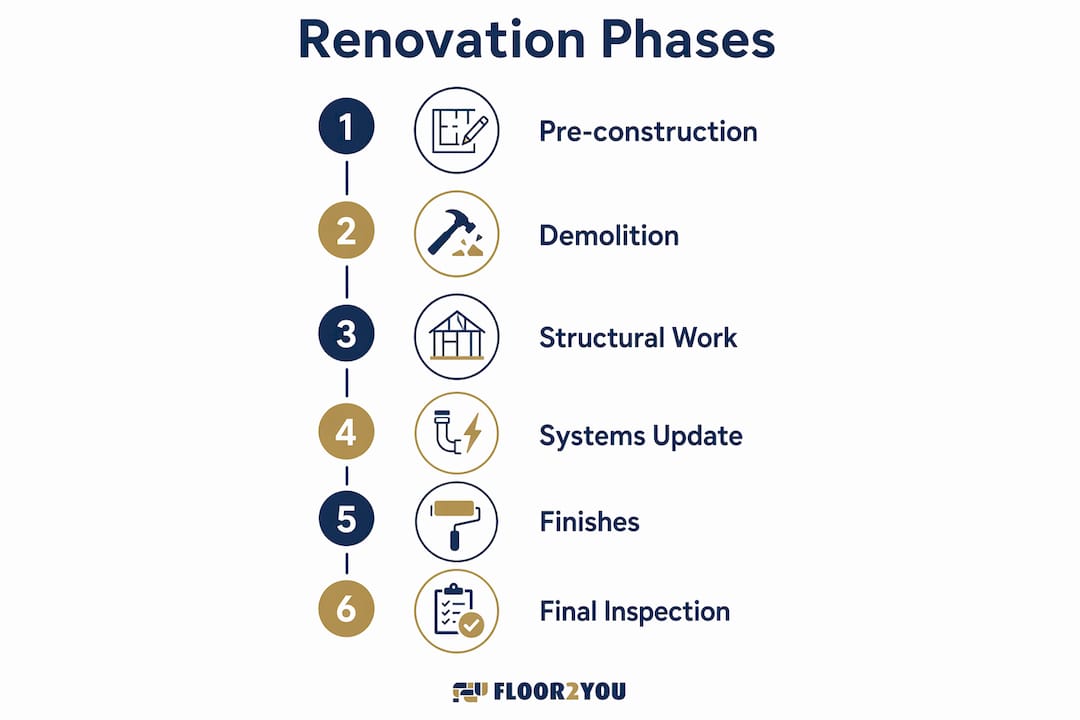
A full home renovation follows a strict sequence enforced by municipal inspection protocols. Each phase must pass inspection before the next begins. Here is the standard project arc for a single-family home:
- Pre-construction inspection: Structural engineer assessment, infrared electrical scan, plumbing pressure test, and wall cavity inspections to identify hidden issues before demolition begins
- Design and permitting: Architectural drawings, structural engineering stamps, and permit applications for building, electrical, mechanical, and plumbing work
- Demolition: Selective or full interior demolition, hazardous material abatement if required, and removal of systems being replaced
- Structural rough-in: Framing modifications, load-bearing work, subfloor repairs, and any foundation work
- Mechanical rough-ins: Plumbing, electrical, and HVAC rough-in installation, each followed by municipal inspection before walls close
- Insulation and drywall: Insulation installation, drywall hanging, taping, and finishing
- Interior finishes: Flooring installation, cabinetry, tile, millwork, painting, and fixture installation
- Final inspections and punch list: All trades receive final inspections, followed by a contractor-led punch list walk to address any remaining items
| Phase | Typical duration | Key milestone |
|---|---|---|
| Pre-construction and permitting | 3 to 6 weeks | Permits issued |
| Demolition and structural | 2 to 4 weeks | Structural inspection passed |
| Mechanical rough-ins | 3 to 5 weeks | All rough-in inspections passed |
| Insulation and drywall | 2 to 3 weeks | Drywall finish complete |
| Finishes and fixtures | 4 to 8 weeks | Punch list issued |
The total project duration for a whole-house renovation typically runs 4 to 9 months, depending on home size, permit processing times, and material lead times. That range is not padding. A 2,000-square-foot home in a municipality with a 6-week permit queue will take longer than the same project in a faster-processing jurisdiction. Planning for the longer end of the range protects your schedule and your budget.
Expert tips and common pitfalls in full-scale remodeling
The single most expensive mistake in whole-house renovation is under-scoping structural work before construction begins. When hidden conditions like outdated knob-and-tube wiring, galvanized plumbing, or deteriorated sheathing are discovered after demolition, the project stops while the scope and budget are renegotiated. That pause costs money in labor standby time and can push material deliveries out of sequence.
Here is what experienced remodeling professionals consistently recommend:
- Invest in a deep pre-construction inspection. Infrared electrical scans and wall cavity openings at key locations reveal conditions that a standard walkthrough misses entirely. The cost is small relative to the change orders it prevents.
- Use an integrated design and build team. When design, engineering, and construction are managed under one team, scope changes get resolved faster, scheduling conflicts are caught earlier, and the project moves with fewer stops.
- Define your change order policy before work starts. Agree in writing on how scope additions are priced and approved. Open-ended change order language is where budgets collapse.
- Plan your living arrangements early. Most whole-house remodels require temporary relocation. If phasing allows you to stay in part of the home, expect to add roughly two weeks to the total timeline.
"The homeowners who have the smoothest projects are the ones who treat the pre-construction phase as seriously as the construction phase. They ask hard questions, review every line of the scope, and do not rush the permit process." — Industry remodeling professional
Pro Tip: Ask your contractor for a written sequencing schedule before signing the contract. If they cannot produce one, that is a signal about how the project will be managed.
How comprehensive remodeling enhances functionality and property value
A whole-house renovation improves market appeal more than piecemeal upgrades because it addresses systems, spatial function, and aesthetics simultaneously. A buyer walking through a home with a renovated kitchen but original 1970s electrical panel and single-pane windows sees a half-finished story. A buyer walking through a home where everything has been updated sees a product they can trust.
The functional benefits are equally significant:
- Mechanical efficiency: New HVAC, updated plumbing, and rewired electrical reduce utility costs and eliminate safety risks from aging systems
- Spatial coherence: Floor plan modifications that improve traffic flow and room relationships make the home genuinely easier to live in, not just better looking
- Unified design language: When flooring, cabinetry, tile, and paint are selected as a system rather than room by room, the home reads as intentional and well-executed
- Code compliance: Bringing the home to current IRC standards protects against liability and simplifies future sales by eliminating disclosure issues around outdated systems
- Durability: New systems and finishes installed correctly under permit carry warranties and inspection records that protect the investment for decades
For South Florida homeowners specifically, the combination of hurricane-resistant windows, updated electrical for modern appliance loads, and moisture-resistant flooring materials makes a full remodel a practical necessity as much as an aesthetic upgrade. The home remodeling costs and value guide from Floor2you covers the return-on-investment side of these decisions in detail.
Key takeaways
Comprehensive remodeling delivers lasting value only when structural, mechanical, and finish systems are planned and executed as one coordinated project rather than a series of isolated upgrades.
| Point | Details |
|---|---|
| Definition is scope-based | Comprehensive remodeling covers most or all major systems and spaces in a single coordinated project. |
| Code compliance is mandatory | Projects exceeding 50% of a home's area trigger Level 3 alteration status, requiring full current-code compliance. |
| Timeline runs 4 to 9 months | Plan for the longer end of that range to account for permitting delays and material lead times. |
| Pre-construction inspection is critical | Infrared scans and wall cavity checks before demolition prevent the change orders that blow budgets. |
| Integrated teams outperform fragmented ones | Single-team management reduces delays, scope creep, and mid-project design conflicts. |
Why most homeowners underestimate what this actually takes
I have seen the same pattern repeat across dozens of projects. A homeowner comes in with a clear vision, a reasonable budget, and a timeline that assumes everything goes right. What they have not accounted for is the invisible layer of the home: the systems behind the walls that have been quietly aging for 30 or 40 years.
The homeowners who finish on budget and on time are not the ones who got lucky. They are the ones who treated the planning phase as the most important part of the project. They hired a structural engineer before the first design meeting. They pulled permits on prior work before signing a contract. They asked their contractor to walk them through the inspection sequence so they understood why the project could not be rushed.
The other thing I would push back on is the idea that a whole-house renovation is primarily about aesthetics. The real value is in the systems. New electrical, updated plumbing, and a properly sized HVAC system change how the home functions every single day. The new floors and fresh paint are visible. The upgraded panel and rerun plumbing are invisible. But the invisible work is what makes the home safe, efficient, and worth what you paid for it.
If you are considering a full-scale remodel, resist the urge to start with finishes. Start with a thorough inspection, a realistic scope, and a team that manages the whole project. The design decisions are the easy part. The planning is where projects succeed or fail.
— G
Start your remodeling project with Floor2you

Floor2you brings South Florida homeowners a single point of contact for full home renovations, from structural coordination through final flooring installation. Whether you are planning a whole-house renovation or starting with kitchens, bathrooms, and flooring, the Floor2you team manages every phase with the same attention to sequencing and quality that large-scale projects demand. Explore Floor2you's renovation services to see project examples, request a quote, and connect with a team that handles the complexity so you do not have to. For homeowners ready to plan their project step by step, the South Florida remodeling guide is a strong place to start.
FAQ
What is the difference between remodeling and renovation?
Renovation refers to restoring or updating existing elements, while remodeling involves changing the structure, layout, or function of a space. Comprehensive remodeling typically includes both, since it replaces systems and reconfigures spaces simultaneously.
How long does a whole-house renovation take?
A full whole-house renovation typically takes 4 to 9 months, depending on home size, permit processing times, and project complexity. Partial renovations covering two to three rooms generally run 2 to 4 months.
Do I need permits for a comprehensive remodel?
Yes. A project affecting more than 50% of a home's area triggers Level 3 alteration requirements under the IRC, requiring building, electrical, mechanical, and plumbing permits with inspections at each phase.
Can I live in my home during a full remodel?
It is sometimes feasible to remain in the home during a phased remodel, but doing so adds roughly two weeks to the total timeline and requires careful coordination with your contractor to maintain safe, livable conditions.
What is the biggest mistake homeowners make in whole-house renovations?
Under-scoping structural and mechanical work before construction begins is the most common error, leading to costly change orders mid-project. A thorough pre-construction inspection, including infrared electrical scans, is the most effective way to prevent it.