

TL;DR:
- Transparency in renovations involves sharing complete, timely project information to prevent surprises and build trust. Clear communication practices, detailed estimates, and documented change orders ensure budgets stay controlled and relationships remain collaborative. Proactive updates and accessible documentation are key to successful, dispute-free remodeling projects.
Transparency in renovations is defined as the practice of sharing complete, timely, and documented information about costs, schedules, decisions, and problems with every party involved in a project. 73% of satisfied clients attribute their renovation satisfaction to transparent communication about budgets and changes, not just the final aesthetic result. That number reframes the entire conversation: homeowners and property managers who focus only on the finished product miss the single biggest driver of a good experience. The role of transparency in renovations is to eliminate surprises, build trust, and give every decision-maker the information they need before problems become disputes.
How does transparency influence budgeting and cost management?
Budget overruns are the most common source of renovation conflict. Transparent budgeting prevents them by forcing every cost assumption into the open before a single wall comes down.
Itemized estimates and allowances
A detailed, line-item estimate does more than show a total price. It separates fixed costs (labor, permits, structural work) from defined selections (tile, fixtures, cabinetry) and unknown allowances (what is behind the walls). Many renovation disputes arise from poorly managed budget allowances rather than workmanship. When a contractor lists a $2,000 tile allowance without explaining that the homeowner's preferred tile costs $6,000, the resulting shock feels like a bait-and-switch. Transparent allowance discussions with realistic cost tiers prevent that feeling entirely.
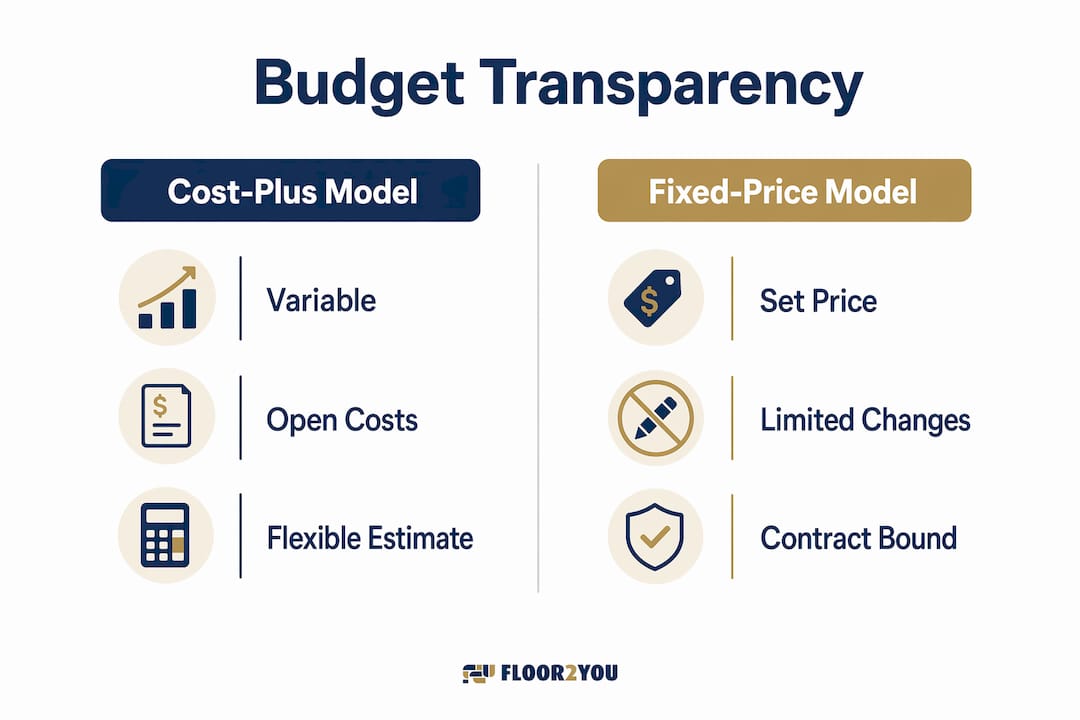
Cost-plus vs. fixed-price models
The contract structure shapes how transparent a contractor can realistically be. Transparency reflects company culture: cost-plus builders embed transparency differently from fixed-price contractors, impacting how detailed and open cost information appears. Cost-plus contracts show every receipt and markup, which builds confidence but requires homeowners to stay engaged. Fixed-price contracts offer simplicity but can obscure where money goes. Neither model is superior by default. The right choice depends on project complexity and how much visibility you want.
Change orders and cost control
Change orders are where budgets collapse when transparency is absent. Top-tier renovation firms report that documenting and obtaining homeowner approval for 100% of change orders before work starts significantly reduces cost overruns. That practice turns a potential conflict into a documented agreement. No work proceeds without a signed approval, which protects both the homeowner and the contractor.
Pro Tip: Ask your contractor to categorize every line item as fixed, defined, or unknown before signing any contract. That single conversation eliminates the most common source of renovation budget shock.
| Budget element | Transparency practice | Outcome |
|---|---|---|
| Labor and permits | Fixed cost, listed separately | No surprises on core project costs |
| Material selections | Defined allowances with cost tiers | Homeowner makes informed choices |
| Hidden conditions | Unknown allowance with review window | Surprises become managed decisions |
| Change orders | Written approval before work starts | Budget stays under homeowner control |
What communication practices build transparency with contractors?
Open communication in home upgrades does not happen by accident. It requires a defined structure that both sides agree to before the project starts.

Scheduled updates and milestone reporting
Weekly progress reports tied to project milestones give homeowners a reliable rhythm. They know when to expect news, which reduces the anxiety of silence. Photo and video documentation at key stages, such as framing, rough plumbing, and electrical rough-in, creates a visual record that words alone cannot match. That record also protects the contractor if a dispute arises later.
Escalation paths for unexpected conditions
Renovations regularly uncover problems: mold behind tile, outdated wiring, or structural issues hidden under flooring. Contracts with formal escalation paths for unexpected conditions, allowing quick homeowner review and approval within 24–48 hours, help control surprises and maintain trust. Without a defined escalation path, contractors either stop work entirely or proceed without approval. Both outcomes damage the relationship.
Technology tools that create visibility
Client portals have changed what transparency looks like in practice. Using client portals that show schedules, invoices, photos, and permit statuses reduces calls and increases homeowner ownership and satisfaction. When a homeowner can log in at 10 PM and see that the permit was approved and tile delivery is scheduled for Thursday, they stop worrying. That peace of mind is a direct product of transparent systems. For property managers overseeing multiple units, this kind of real-time visibility is not a luxury. It is a requirement.
- Scheduled weekly updates tied to project milestones
- Photo and video logs at each major stage
- Written change order approvals before any scope change
- Client portals with live schedule, invoice, and permit access
- Defined escalation windows (24–48 hours) for hidden conditions
Pro Tip: Before signing a contract, ask the contractor to show you a sample client portal or documentation package from a past project. How they document others predicts how they will document yours.
How does openness affect trust between homeowners and contractors?
Trust in construction is not built by finishing on time and on budget alone. It is built by how a contractor handles the moments when things go wrong.
"Homeowners understand construction challenges but expect honesty, responsiveness, and professionalism. Transparency does not eliminate problems. It eliminates surprises."
Transparency shifts the renovation dynamic from defensive guarding to collaborative trust, accelerating decision-making by days or even weeks. When a contractor discloses a delay immediately and presents two or three options for handling it, the homeowner becomes a partner in the solution rather than a victim of the problem. That shift changes the entire tone of the project.
Homeowners prize proactive delivery of bad news about delays or hidden costs, along with clear options, over concealing issues. This is counterintuitive for contractors who fear that bad news will damage the relationship. The opposite is true. Concealment destroys trust. Early disclosure, paired with solutions, builds it.
Trust also grows through shared decision-making. When a homeowner approves a material substitution in writing, they own that decision. They cannot later claim the contractor made a unilateral choice. That documented shared ownership is one of the most underrated benefits of a transparent renovation process.
- Early disclosure of delays and cost changes builds confidence
- Presenting multiple options when problems arise shifts the dynamic to collaborative
- Written approvals create shared ownership of decisions
- Consistent communication style signals professionalism and reliability
- Transparency as risk mitigation protects both parties from disputes
For exterior projects, the same principle applies. Protecting adjacent work, like landscaping during a roof replacement, requires the same proactive disclosure and documented agreements that interior renovations demand.
What steps can homeowners and investors take to protect themselves?
Building trust in home renovations starts before the first tool arrives. The steps below apply whether you are renovating a primary residence, a rental unit, or an investment property.
-
Request a line-item estimate. Ask for costs broken into fixed, defined, and unknown categories. Reject any estimate that gives only a lump sum without explanation.
-
Clarify every allowance upfront. Ask the contractor to show you three price tiers for each material allowance. That conversation reveals whether the allowance is realistic for your taste level.
-
Insist on written change order procedures. Before signing the contract, confirm that no scope change proceeds without your written approval. Get that requirement in the contract itself.
-
Assign a single point of contact. Whether that is a dedicated project manager or the lead contractor, one person should own all communication. Multiple contacts create gaps and contradictions.
-
Use technology tools. Ask whether the contractor uses a client portal, photo log, or project management software. If they do not, request weekly written updates by email as a minimum standard.
-
Set contract terms for escalation. Require a defined review window, such as 24–48 hours, for any unexpected condition discovered during work. That window keeps the project moving without forcing rushed decisions.
-
Review documentation regularly. Read every invoice, change order, and progress report. Ask questions early. A question asked in week two is far cheaper than a dispute in week eight.
Pro Tip: For investment properties or multi-unit renovations, use a shared folder (Google Drive or Dropbox) where the contractor uploads all photos, invoices, and approvals in real time. You get full visibility without daily check-in calls.
Avoiding common remodeling mistakes starts with the contract, not the construction phase. The homeowners who experience the smoothest projects are the ones who asked the hardest questions before work began.
Key Takeaways
Transparent communication, documented change orders, and defined escalation paths are the three practices that determine whether a renovation succeeds or becomes a dispute.
| Point | Details |
|---|---|
| Transparency drives satisfaction | 73% of satisfied clients credit transparent communication, not aesthetics, for their positive experience. |
| Change orders prevent overruns | Requiring written approval before any scope change keeps budgets under homeowner control. |
| Escalation paths reduce anxiety | A 24–48 hour review window for hidden conditions turns surprises into managed decisions. |
| Technology increases ownership | Client portals with live schedules and invoices reduce calls and increase homeowner confidence. |
| Early bad news builds trust | Proactive disclosure of delays, paired with options, shifts the relationship from adversarial to collaborative. |
What I have learned after watching renovations go wrong
The renovations that go sideways rarely fail because of bad craftsmanship. They fail because someone withheld information at the wrong moment. I have seen projects where the contractor knew about a structural problem in week two and said nothing until week six. By then, the homeowner felt deceived, the relationship was broken, and the dispute cost more in time and legal fees than the original fix would have.
The contractors who consistently deliver great outcomes share one trait: they communicate before they are asked. They send the photo before the homeowner texts. They flag the delay before it shows up on the schedule. They present the change order before the work is done. That proactive posture is not just good manners. It is a business model.
Trust grows through clear, early communication of good and bad news paired with multiple solution options, especially for high-stakes projects. That insight applies equally to a $15,000 bathroom remodel and a $300,000 full home renovation. The scale changes. The principle does not.
My honest advice: if a contractor cannot show you a sample of how they document a past project, walk away. Documentation is not paperwork. It is proof that they take your money and your home seriously.
— G
Floor2you's approach to transparent home renovation

Floor2you builds its entire project process around the communication practices described in this article. From the first quote through final walkthrough, every cost, change, and decision is documented and shared with the homeowner. South Florida homeowners, property managers, and real estate investors can review full renovation services that include itemized estimates, written change order procedures, and dedicated project management. For those planning flooring upgrades alongside a broader remodel, Floor2you's flooring project management process keeps material selections, timelines, and costs visible at every stage. Reach out for a quote and see what a transparent renovation process looks like from day one.
FAQ
What is the role of transparency in renovations?
Transparency in renovations means sharing complete, timely information about costs, schedules, and problems with all parties. It eliminates surprises and is the primary driver of homeowner satisfaction.
How do change orders relate to budget transparency?
A signed change order, approved before work begins, documents every scope change and its cost. This practice prevents the budget overruns that cause most renovation disputes.
What communication tools improve renovation transparency?
Client portals that display schedules, invoices, photos, and permit statuses give homeowners real-time visibility. Weekly written updates and photo logs serve as a minimum standard when portals are not available.
Why does early disclosure of problems build trust?
Homeowners expect honesty and responsiveness, not perfection. Proactive delivery of bad news, paired with clear options, shifts the dynamic from adversarial to collaborative and strengthens the working relationship.
How should property managers handle transparency across multiple units?
Assign a single point of contact for each project and use shared digital folders or client portals to centralize all documentation. That structure gives property managers full visibility without requiring daily on-site presence.