

TL;DR:
- South Florida floors need specialized routines due to heat, humidity, and sand.
- Moisture control and appropriate flooring materials are essential for long-term durability.
- Regular inspections, seasonal deep cleaning, and local expertise help protect floors effectively.
Living in South Florida means your floors work harder than almost anywhere else in the country. Intense heat, year-round humidity that regularly sits above 70%, and sand tracked in from every beach trip or backyard visit create a relentless combination that wears floors down fast. Most national cleaning guides assume a dry, temperate home, which makes their advice a poor fit for what you are dealing with every day here. This guide breaks down exactly what South Florida homeowners need to do to protect their floors, preserve their appearance, and dramatically extend their lifespan, with routines and strategies built specifically for this climate.
Table of Contents
- Start with the right cleaning routine
- Protect against South Florida's humidity and moisture
- Handle high-traffic and sandy areas for long-lasting floors
- Seasonal and deep-cleaning maintenance for maximum lifespan
- Why proactive, local-focused floor care outperforms generic advice
- Upgrade your South Florida floors with expert guidance
- Frequently asked questions
Key Takeaways
| Point | Details |
|---|---|
| Damp clean weekly | Use a microfiber mop and pH-neutral cleaner with minimal water for best floor care. |
| Control humidity risks | Prioritize moisture inspections and rotate rugs to prevent mold and hidden damage. |
| Combat sand and grit | Daily grit removal and entry mats are your best tools for floor longevity in South Florida. |
| Customize deep cleaning | Seasonal furniture rotation and grout cleaning add years to your floor’s life. |
Start with the right cleaning routine
Once you understand the local risks, it is critical to develop a cleaning routine built for these conditions. A cleaning schedule that works in Ohio or Colorado can actually cause damage when applied in a humid, sandy environment like Miami, Fort Lauderdale, or Boca Raton. The goal is not just cleanliness. It is prevention.
The single most important habit you can build is responding to spills immediately. In South Florida's heat, liquid seeps into grout lines, beneath vinyl edges, and into hardwood grain faster than in cooler climates. Following how to deep clean hardwood floors recommendations means you should wipe spills immediately and rely on damp rather than wet mopping weekly, using pH-neutral, floor-specific cleaners that do not leave behind residue or cause swelling.
pH-neutral cleaners are the gold standard for tile, hardwood, and luxury vinyl plank because they clean effectively without breaking down protective sealants or finishes. Acidic cleaners like vinegar, even diluted, etch grout lines over time. Alkaline cleaners leave behind a filmy haze that builds up with every wash. A simple pH-balanced floor cleaner from any hardware store will always outperform kitchen shortcuts.
The tool you use matters just as much as the product. Microfiber mops extract 99.3% of fine particles compared to traditional string mops, and daily grit removal extends floor life two to three times longer in sandy environments. That number is not exaggerated. Fine sand particles act like sandpaper under foot traffic, grinding down your floor's finish every single day. A microfiber dry mop used every morning in entryways and common areas makes a measurable difference over months and years. To explore what professional flooring care looks like at a deeper level, the approach always starts with consistent surface maintenance before any deep work.
Quick-reference cleaning checklist:
- Dry dust or dry mop all hard floors daily, especially entryways and hallways
- Wipe up spills immediately using a clean, dry cloth
- Damp mop with a pH-neutral cleaner weekly, using a well-wrung microfiber mop
- Check mop pad for sand and debris before each pass to avoid redistributing grit
- Deep clean grout lines monthly in tile areas, especially kitchens and bathrooms
- Inspect baseboards and floor edges for moisture or discoloration after rainy periods
Pro Tip: Never use a steam mop on hardwood, vinyl, or tile in South Florida. The heat forces moisture into seams and can warp hardwood, loosen adhesive under vinyl, and crack grout. Even if the manufacturer says your floors are steam-safe, the added humidity in this climate amplifies the risk significantly.
For homeowners with hardwood, solid wood floors require the gentlest approach. You can learn more about hardwood floor cleaning to understand how moisture interacts with wood grain at a structural level, which will change how you approach every cleaning session.
Protect against South Florida's humidity and moisture
Proper cleaning is essential, but humidity control is equally critical in South Florida's climate. Even a well-maintained floor can buckle, warp, or develop mold beneath the surface when ambient moisture is not managed. This is where many homeowners lose the battle without ever knowing it.
Seasonal inspection is not optional here. Consumer Reports recommends that homeowners inspect for moisture damage, rotate rugs and furniture, and deep clean grout and vents on a seasonal schedule. In South Florida, with a rainy season running from roughly June through October, a pre-season check in late May and a post-season check in November is a smart minimum.
Here is a step-by-step inspection process you can do yourself:
- Lift area rugs and furniture pads and check for any discoloration, softness, or musty odor beneath them
- Press gently on hardwood boards or vinyl plank sections to feel for soft spots indicating subfloor moisture
- Run your finger along grout lines and look for cracking, darkening, or crumbling, all signs of moisture infiltration
- Check HVAC vents near the floor for dust buildup or mold growth, which spreads spores across your floor surface
- Look at baseboards and floor transitions for gaps that have widened, often caused by wood swelling from humidity
Rotating rugs and furniture is more than an aesthetic choice. When you leave a rug in one place for months in a humid climate, you create a micro-environment underneath it. Trapped heat and moisture encourage mold growth, especially on carpeted surfaces or organic-material area rugs.
Tile and luxury vinyl plank are the clear winners for South Florida humidity. Both resist moisture at the surface level and, when properly installed with the right underlayment and sealed grout, create a near-impenetrable barrier. Carpet remains viable only with strict humidity control and synthetic fibers, but even then carries a significantly higher mold risk than hard surface flooring alternatives.
Choosing the best flooring types for humidity before you install is the most cost-effective protection you can give yourself. Retrofitting a poorly chosen floor is far more expensive than selecting the right material from the start.
Pro Tip: Run your air conditioning and a supplemental dehumidifier in rooms where you have carpet or solid hardwood floors. Keeping indoor humidity between 40% and 60% is the target. South Florida outdoor air regularly exceeds 80% humidity, and your AC alone may not be enough during peak rainy season. If you are choosing moisture-resistant tile, look for porcelain over ceramic, as porcelain has a lower water absorption rate.
Handle high-traffic and sandy areas for long-lasting floors
Beyond moisture, South Florida's sandy entrances require their own tailored approach to combat wear and tear. The beach lifestyle is one of the best parts of living here, but it is genuinely brutal on floors. Every time someone walks in from the driveway, patio, or garage, they bring a thin layer of silica sand that is invisible to the eye but deeply damaging over time.
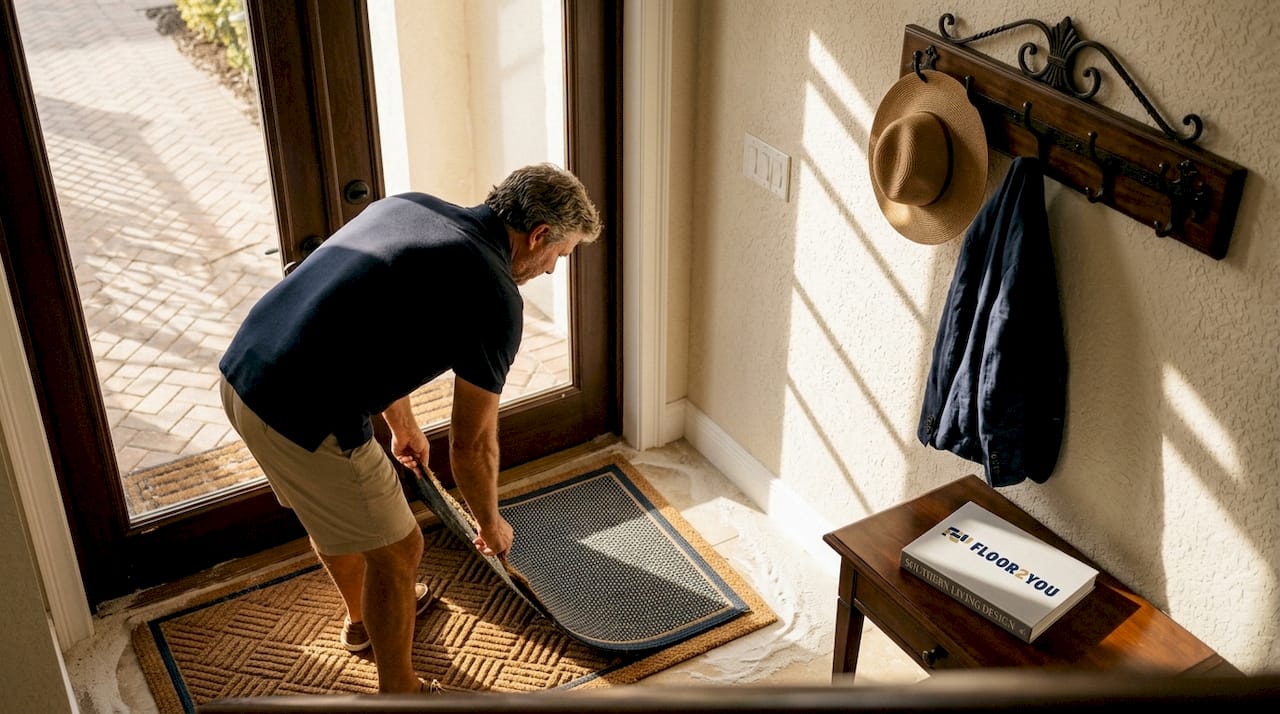
The first line of defense is entry mats. A double-mat system, one outside and one inside every exterior door, traps the majority of sand before it reaches your main floor surfaces. Replace or shake out these mats at least twice a week during summer and daily during heavy beach or outdoor activity periods.
Best flooring choices for high-traffic zones:
- Porcelain tile: Extremely durable, scratch-resistant, and easy to sanitize; ideal for entryways and main living areas
- Luxury vinyl plank (LVP): Resilient, waterproof, and comfortable underfoot; handles daily grit exceptionally well
- Laminate: More affordable but needs careful moisture management near doors and in open-plan layouts
- Hardwood: Beautiful but requires more diligent maintenance in high-traffic zones; better suited for bedrooms in South Florida
Consumer Reports confirms that porcelain tile and vinyl are the most durable options for high-traffic areas, which aligns perfectly with South Florida's environment. And because microfiber mops extract 99.3% of fine particles, using one daily in entryways compounds the protective effect of your mats and significantly extends floor life.
Durability comparison for South Florida high-traffic areas:
| Flooring type | Scratch resistance | Moisture resistance | Ease of cleaning | Best location |
|---|---|---|---|---|
| Porcelain tile | Excellent | Excellent | Easy | Entryways, kitchens, bathrooms |
| Luxury vinyl plank | Very good | Excellent | Very easy | Living rooms, hallways |
| Laminate | Good | Fair | Easy | Bedrooms, low-traffic areas |
| Hardwood | Fair | Poor | Moderate | Bedrooms only |
| Carpet | Poor | Poor | Difficult | Minimal use in South Florida |
To prevent scuffing in these zones, add felt pads to all furniture legs and avoid dragging anything across the floor. Heavy furniture that gets moved frequently, like dining chairs, causes the most concentrated surface damage. The vinyl flooring advantages in South Florida are particularly strong in entryways and kitchens because of this exact combination of moisture resistance and scratch durability.
Pro Tip: Set up an entry rug rotation schedule. Keep two sets of mats and swap them every two weeks. While one set is in use, the other gets a thorough wash and dry. This keeps sand-trapping effectiveness high and prevents mats themselves from becoming a source of tracked dirt. If you are weighing your vinyl flooring options, thicker wear layers of 12 mil or more hold up significantly better in entry zones.
Seasonal and deep-cleaning maintenance for maximum lifespan
Even with steady daily routines, periodic deep-cleaning tasks make a decisive difference in floor longevity. Think of daily and weekly cleaning as the maintenance that keeps things stable, and seasonal deep cleaning as the reset that catches everything your routine misses.
South Florida's rainy season is the biggest stress test your floors face each year. Before it starts, typically around late May, is the ideal time to complete a thorough deep-cleaning session. Seasonal maintenance should include inspecting for moisture damage, rotating rugs and furniture, and deep cleaning grout and vents to remove buildup that promotes mold and reduces air quality.
Here is a practical seasonal maintenance schedule:
- Late May (pre-rainy season): Deep clean all grout lines using a stiff-bristle brush and a non-acidic grout cleaner; reseal grout if it has been more than a year since the last seal; inspect and clean all HVAC floor vents
- August (mid-season check): Inspect under area rugs and furniture for moisture, lift and air out rugs for 24 to 48 hours, dry mop all hard surfaces thoroughly
- November (post-season): Full floor inspection for warping, soft spots, or cracked grout; deep clean all floor surfaces; rotate furniture to distribute wear patterns evenly
- February (dry season reset): Refinish or apply protective coating to hardwood if needed; address any surface scuffs or scratches before they deepen; clean and inspect baseboards
Routine cleaning vs. deep cleaning comparison:
| Task | Routine cleaning | Deep cleaning |
|---|---|---|
| Mopping | Weekly damp mop | Full scrub with concentrated cleaner |
| Grout care | Surface wipe | Brush scrubbing plus sealing |
| Furniture | Wipe legs | Lift and inspect underneath |
| Vents | Dust removal | Full vent cleaning and inspection |
| Frequency | Daily to weekly | Every 3 to 6 months |
Understanding the 2026 flooring trends also helps you make smarter decisions about what surfaces to choose when it is time to replace or upgrade, as newer materials often incorporate better moisture barriers and easier-to-clean finishes. And getting the flooring underlayment tips right at installation time reduces moisture transfer from the subfloor upward, which makes your entire maintenance routine easier.
Pro Tip: Schedule your deep clean at least two weeks before South Florida's rainy season peaks. This gives any resealing products, floor treatments, or freshly cleaned grout time to fully cure before the heavy humidity arrives. Sealing grout or refinishing hardwood just before a high-humidity period locks the protection in while the floor is at its cleanest and driest.
Why proactive, local-focused floor care outperforms generic advice
Most of the floor care content you find online is written for a national audience, and that audience lives in homes that are fundamentally different from yours. The average American home sits in a drier, more temperate climate where humidity is a seasonal issue, not a year-round reality. Those guides tell you to open windows for ventilation and to let floors air dry naturally. In South Florida, that advice lets humid air pour in and dramatically accelerates the very problems you are trying to prevent.
We have seen firsthand what happens when homeowners follow generic advice here. Hardwood floors cupped after a homeowner used a steam mop because an article said it was safe. Grout crumbled within two years because a popular vinegar rinse stripped the sealer. Carpet developed mold underneath it because nobody told the homeowner that 78% indoor humidity during August was enough for mold to grow on a dry-looking floor.
The smart move is always to favor locally tailored flooring choices and cleaning routines that reflect the actual conditions in your home. What works in your neighbor's house in Broward County is going to be more relevant than what an influencer recommends from a studio in Seattle. Lean into moisture-resistant materials, daily grit removal, and a seasonal inspection habit. Those three things alone will put your floors ahead of most South Florida homes.
Upgrade your South Florida floors with expert guidance
Maintaining your floors well is the first step, but sometimes the right move is a complete upgrade to materials that actually suit this climate from day one.

At Floor2You, we specialize in exactly that. Our team works with South Florida homeowners every day, helping them select flooring materials built for humidity, sand, and heavy foot traffic, then installing them with the precision and care that makes long-term maintenance easier. Whether you are considering porcelain tile, luxury vinyl plank, or a full home renovation, we bring local expertise and a proven process to every project. Reach out today to schedule a consultation and find out which flooring solution fits your home, your lifestyle, and your South Florida reality.
Frequently asked questions
How often should I deep clean my floors in South Florida?
Deep cleaning every 3 to 6 months is strongly recommended to address the humidity, sand, and mold risks that are common in South Florida homes. Seasonal maintenance including grout care, vent cleaning, and moisture inspection keeps floors in top condition year-round.
Is it safe to use vinegar or steam cleaners on vinyl or tile floors?
No, both should be avoided because vinegar strips protective sealants and steam cleaners force excess moisture into seams and grout. Avoiding steam mops and vinegar on hardwood, tile, and vinyl prevents swelling, haze, and long-term surface damage.
What is the best way to keep sand off my floors?
Use double-layer entry mats at every exterior door, dry mop daily with a microfiber mop, and rotate rugs regularly. Microfiber mops extract 99.3% of fine particles and daily grit removal extends floor life two to three times longer in sandy environments.
How can I prevent mold from growing under carpets?
Lift and rotate rugs regularly, use only synthetic carpet materials, and keep indoor humidity between 40% and 60% using air conditioning and a dehumidifier. Carpet carries a higher mold risk compared to tile or vinyl in humid climates and requires strict environmental control to stay mold-free.