
TL;DR:
- South Florida's high humidity and shallow water table cause unique flooring challenges.
- Professional moisture testing and proper installation prevent costly failures and mold growth.
- Investing in expert installation ensures long-lasting, resilient floors suited for the climate.
South Florida's climate is not just a backdrop to your home remodel. It is an active force working against your floors every single day. High humidity, concrete slab construction, and a water table that sits unusually close to the surface create conditions that can turn a beautiful new floor into a warped, moldy mess within months. Many homeowners discover this the hard way after a DIY install or a budget contractor job. This article breaks down exactly why professional flooring installation is not just a luxury in South Florida. It is a practical necessity that protects your investment and your home.
Table of Contents
- What makes South Florida flooring unique?
- How do professionals ensure a lasting floor?
- What risks do DIY or unskilled installs carry?
- How professionals maximize design and value
- Why cutting corners rarely pays off: An expert perspective
- Upgrade your home with expert flooring services
- Frequently asked questions
Key Takeaways
| Point | Details |
|---|---|
| South Florida challenges | High water tables and humidity make specialized flooring methods essential for lasting results. |
| Professional advantages | Expert installers use proper tools and standards to prevent common and costly flooring failures. |
| DIY risks | Non-professional installs often lead to hidden damage, expensive repairs, or quick deterioration. |
| Value and design | Professionals help pick the right material and style, maximizing both comfort and property value. |
What makes South Florida flooring unique?
Most parts of the country deal with seasonal moisture swings. South Florida deals with moisture constantly. The average relative humidity here hovers between 70% and 90% for much of the year, and the water table in many areas sits just a few feet below your foundation. That combination creates a flooring environment unlike almost anywhere else in the United States.
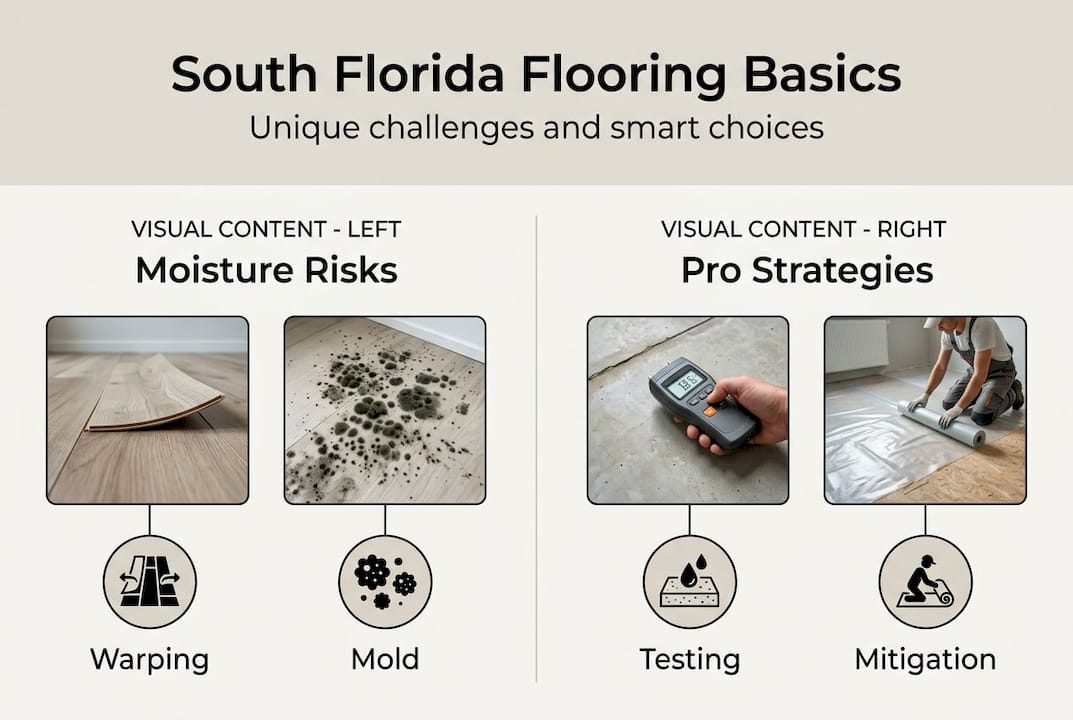
Almost every home in South Florida sits on a concrete slab rather than a raised wood subfloor. Concrete looks solid, but it is actually porous. It absorbs and releases moisture vapor continuously, and concrete slabs in South Florida require moisture testing and mitigation to prevent flooring failures due to high water tables. When that moisture vapor pushes up through the slab and meets your flooring adhesive or material, the results can be devastating.
Here are the most common flooring problems caused by South Florida's unique conditions:
- Adhesive failure: Moisture vapor breaks down the bond between adhesive and flooring material, causing tiles or planks to lift.
- Delamination: Layered flooring products like engineered hardwood or laminate separate internally when moisture infiltrates.
- Warping and buckling: Solid hardwood and even some vinyl products expand unevenly when moisture levels fluctuate.
- Mold growth: Trapped moisture under flooring creates ideal conditions for mold, which can spread into walls and subfloors.
Professionals measure slab moisture using a metric called MVER (Moisture Vapor Emission Rate). For most flooring types, the slab must read below 3 to 5 lbs per 1,000 square feet per 24 hours before installation begins. For tile work specifically, tile installation benchmarks require at least 95% adhesive contact in wet areas like bathrooms and kitchens. These are not suggestions. They are standards that protect your floor long term.
| Flooring type | Max acceptable MVER | Key risk if exceeded |
|---|---|---|
| Solid hardwood | 3 lbs/1,000 sqft/24hr | Warping, cupping |
| Engineered hardwood | 5 lbs/1,000 sqft/24hr | Delamination |
| Vinyl plank | 5 lbs/1,000 sqft/24hr | Adhesive failure |
| Ceramic/porcelain tile | Varies by adhesive | Grout cracking, lift |
Understanding the best flooring types for South Florida homes starts with understanding these moisture realities. Skipping this step is where most problems begin.
How do professionals ensure a lasting floor?
The difference between a floor that lasts 20 years and one that fails in 18 months often comes down to the preparation work done before a single plank is laid. Professionals follow a disciplined process that most DIYers and budget contractors skip entirely.
Here is what a qualified flooring professional does on every job:
- Moisture testing: Using a calcium chloride test or in-situ probe, the slab is tested for MVER before any work begins.
- Moisture mitigation: If readings are too high, a vapor barrier or epoxy moisture barrier is applied to the slab.
- Surface preparation: The slab is ground, patched, and leveled so the flooring has a flat, clean surface to bond to.
- Adhesive selection: Professional-grade adhesives are chosen specifically for the flooring type and moisture conditions present.
- Installation to standard: Whether it is professional hardwood installation or tile, every section is checked for proper contact and coverage.
- Curing and inspection: Floors are allowed to cure fully before foot traffic, and a final inspection confirms there are no voids or weak spots.
One area where professionals clearly outperform DIY is epoxy flooring. Pro epoxy is 3 to 5 times thicker than most DIY kits, which means it stands up to South Florida's humidity and heavy use far better. Thin DIY coatings peel and chip within a year or two, while professional applications can last a decade or more.
Choosing the right flooring underlayment is another step that separates professional results from amateur ones. The underlayment acts as a buffer between the slab and the flooring material, managing minor moisture fluctuations and adding cushioning.
Pro Tip: Always ask your flooring contractor to show you the moisture test results before installation begins. A reputable professional will have documentation. If they cannot provide it, that is a red flag.
Professionals also use slab moisture mitigation products that are simply not available at retail stores. These industrial-grade vapor barriers and adhesives are formulated to handle the specific demands of South Florida construction, and they make a measurable difference in long-term performance.
What risks do DIY or unskilled installs carry?
Let us be direct. A flooring mistake in South Florida does not just look bad. It can cost you thousands of dollars and create health hazards in your home. The risks are real, and they often do not show up immediately.
Improper moisture control can cause adhesive failure and delamination, especially in humid environments like South Florida. By the time you see the problem, the damage underneath is usually far worse than what is visible on the surface.
Here are the most common warning signs of a failed flooring install:
- Tiles popping or cracking along grout lines, especially in bathrooms and kitchens
- Planks buckling or lifting at the edges or seams
- Soft spots underfoot that indicate delamination or subfloor rot
- Musty odors that signal mold growth trapped beneath the floor
- Visible gaps between planks that widen over time as moisture cycles
The financial impact is significant. Repairing a failed floor typically costs more than the original installation because you have to pay for tear-out, disposal, subfloor remediation, mold treatment if needed, and then a full reinstall. What might have cost $4,000 to do correctly the first time can easily turn into a $10,000 or $12,000 repair project.
"The most expensive floor is the one you have to install twice."
There is also a timing factor unique to South Florida. Many flooring failures that were quietly developing beneath the surface get exposed during hurricane season. Heavy rain, flooding, and extreme humidity spikes accelerate moisture damage. Homeowners who had a questionable install done in the spring often discover the full extent of the problem by September.
If you are considering vinyl flooring options or working through a tile flooring selection, understanding these risks upfront will help you make a smarter choice from the start.
How professionals maximize design and value
Beyond avoiding disasters, professional flooring installers bring something that is harder to quantify but just as important: design expertise and product knowledge that helps you get the most out of your investment.
Professionals understand product specifications in ways that matter. For example, glue-down hardwood requires slab moisture below 12% RH and 95% tile contact coverage to perform as intended. Without that knowledge, even a beautiful material choice can fail in execution.
Here is how experienced installers add value beyond the technical side:
- Material matching: They know which products hold up to South Florida's climate and which ones look great in the showroom but fail in the field.
- Design consultation: Professionals can suggest layouts, patterns, and color palettes that complement your home's architecture and maximize visual appeal.
- Trend awareness: Staying current with modern flooring trends means you get materials that look fresh today and hold their appeal for years.
- Resale value guidance: The right flooring choice can meaningfully increase your home's market value, and pros know which upgrades buyers in South Florida actually respond to.
- Preventing costly mismatches: A professional consultation catches potential problems before you purchase materials, saving you from expensive returns or mid-project changes.
The advantages of vinyl flooring in South Florida, for instance, are significant, but only when the right product grade is selected and installed correctly. Luxury vinyl plank installed over a properly prepared slab with the right underlayment can outperform hardwood in this climate at a fraction of the cost.
Pro Tip: Ask your installer about the full lifecycle cost of each material option, not just the upfront price. A slightly more expensive product that lasts 25 years beats a cheaper one that needs replacement in 8.
Smart homeowners treat flooring as a long-term asset. Professionals help you think that way from day one.
Why cutting corners rarely pays off: An expert perspective
After working on hundreds of South Florida homes, we have seen a pattern that repeats itself. A homeowner saves a few hundred dollars by hiring an unlicensed installer or attempting a DIY project. Everything looks fine for six months. Then the rainy season hits, the humidity climbs, and the floor starts to move.
The uncomfortable truth is that flooring in South Florida is not a commodity purchase. It is a technical installation that requires local knowledge, proper tools, and materials suited to this specific environment. Cutting corners on labor does not save money. It defers a larger expense.
We also see homeowners focus too much on the material and not enough on the installation process. A premium floor installed poorly will fail faster than a mid-range floor installed correctly. The installation is where the real value is created.
When you are choosing the right flooring for your South Florida home, think of it as a long-term security decision. The homeowners who come out ahead are the ones who invest in doing it right the first time.
Upgrade your home with expert flooring services
If this article has made one thing clear, it is that South Florida flooring requires more than a good eye for design. It requires technical knowledge, the right tools, and experience with local conditions.

At Floor2You, we connect South Florida homeowners with flooring professionals who understand every challenge this climate presents. From moisture testing and vapor barrier installation to material selection and final inspection, our team manages every step of the process. Whether you are remodeling a kitchen, updating a living area, or refreshing an entire home, we make sure your floors are built to last. Reach out today for a consultation and get a clear plan for your project.
Frequently asked questions
What happens if slab moisture isn't tested before flooring installation?
Skipping moisture testing can cause adhesive failure and delamination, leading to costly repairs and damaged flooring that often requires a full reinstall.
Can I install hardwood directly on a concrete slab?
Hardwood should only be glued down if slab moisture is below 12% RH; otherwise, the wood risks warping, cupping, and premature failure.
Is professional installation really worth the extra money?
Yes. Professional installation methods address slab moisture and adhesive standards that DIY installs routinely miss, saving you from far more expensive repairs later.
Are all flooring types equally affected by South Florida's humidity?
No. Some materials are significantly more resilient in humid climates, and humidity-resistant flooring options vary widely in performance. A professional can match the right product to your specific home conditions.