

TL;DR:
- Home renovation ROI measures how much of your investment is recovered in home value at sale, guiding smart project choices. Exterior curb appeal and minor interior updates offer the highest returns, while major upgrades often yield lower percentages and over-investment risks. Calculating ROI using local data and market ceilings helps homeowners make financially sound renovation decisions.
Home renovation ROI is the percentage of your renovation costs you recover in added home value at sale, and it determines which projects actually pay off financially. Industry analysts define it as (value added to home / cost of renovation) x 100%, where 100% means you broke even and anything above means profit. Most projects fall below that threshold, which surprises many homeowners who assume spending more automatically means earning more. The 2026 Cost vs. Value Report confirms that returns vary dramatically by project type, scope, and location. Knowing what is home renovation ROI before you pick up a hammer is the difference between a smart investment and an expensive mistake.
What is home renovation ROI and how does it work?
Home renovation ROI measures how much of your remodeling spend comes back to you when you sell. The formula is straightforward: divide the value added to your home by the total cost of the renovation, then multiply by 100. A $10,000 kitchen refresh that adds $9,600 in resale value delivers a 96% ROI. You spent $400 net, which is far better than a $75,000 major kitchen overhaul that returns only 38–59% of costs.
ROI below 100% does not mean a renovation was a bad decision. It means you did not fully recoup the cost through resale value alone. Some projects improve your daily life, attract buyers faster, or prevent costly repairs down the road. The financial return is one part of the equation, not the whole picture. That said, if your primary goal is maximizing resale value, the numbers should guide every decision you make.
Which renovation projects deliver the best ROI?
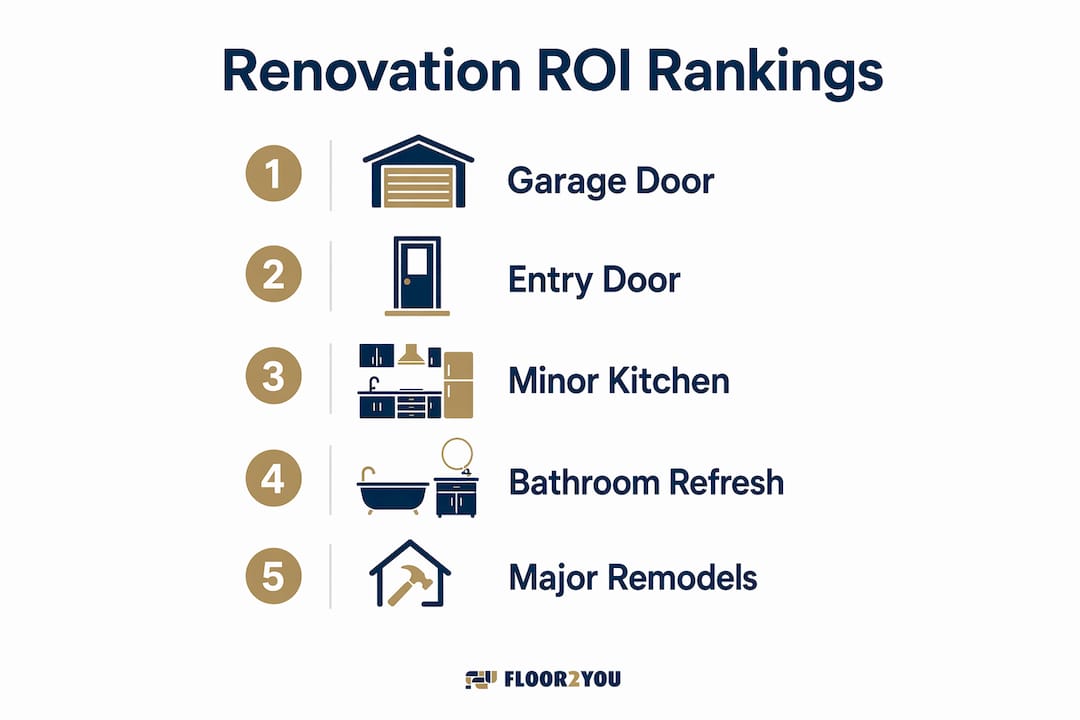
Exterior curb appeal projects dominate the top of the ROI rankings, and the gap between them and interior remodels is striking. According to 2026 Cost vs. Value data, garage door replacement delivers a 194% ROI, manufactured stone veneer returns 153%, and a steel entry door replacement comes in at 82%. These projects cost relatively little and create immediate visual impact that buyers notice before they ever step inside.

Curb appeal projects offer the most leverage because a low investment dramatically increases buyer interest and perceived value. Interior projects follow a different pattern. Minor kitchen remodels and bathroom refreshes consistently outperform their major counterparts because buyers want move-in ready finishes, not luxury upgrades they did not choose themselves.
The table below compares the top projects by average cost, value added, and ROI based on 2026 industry data:
| Project | Avg. Cost | Value Added | ROI % |
|---|---|---|---|
| Garage door replacement | $4,500 | $8,730 | 194% |
| Manufactured stone veneer | $11,000 | $16,830 | 153% |
| Steel entry door replacement | $2,400 | $1,970 | 82% |
| Minor kitchen remodel | $26,500 | $25,440 | 96% |
| Minor bathroom refresh | $12,000 | $8,520 | 71% |
Pro Tip: Before committing to any interior renovation, check comparable sales in your neighborhood. If nearby homes sell without granite countertops, adding them will not move your price ceiling.
How do minor vs. major remodels compare in ROI?
The ROI gap between minor and major remodels is one of the most counterintuitive findings in residential real estate. Minor midrange kitchen remodels return about 96% ROI while major upscale kitchen renovations return only 38–59%. A minor kitchen remodel typically costs $25,000–$28,000 and covers cabinet refacing, new hardware, updated appliances, and fresh countertops. A major remodel at $75,000–$150,000 or more replaces everything, often with finishes that exceed what buyers in the neighborhood expect to pay for.
Minor bathroom refreshes follow the same pattern, returning around 71% ROI compared to 54% for major bathroom overhauls. The reason is buyer psychology. Most buyers want a home that feels updated and clean, not one that has been over-customized. Luxury finishes signal higher price expectations without guaranteeing buyers will meet them.
Here is how the two approaches compare at a glance:
- Minor remodel: Lower budget ($25,000–$28,000 for kitchens), targets cosmetic updates, returns 70–96% ROI, appeals to the widest buyer pool
- Major remodel: Higher budget ($75,000–$150,000+ for kitchens), full structural and finish overhaul, returns 38–59% ROI, carries over-improvement risk
- Over-improvement risk: Investing beyond roughly 30% of home value often triggers diminishing returns regardless of project quality
- Sweet spot: Cosmetic refreshes that modernize without exceeding neighborhood price ceilings
Real estate professionals consistently note that buyers prefer move-in ready homes with modern but not necessarily luxury finishes. That preference is exactly why a $500 coat of paint often outperforms a $50,000 bathroom gut job on a per-dollar basis. For more on cost-effective kitchen updates that maximize resale value, the principle is the same: refresh, do not rebuild.
What factors influence renovation ROI beyond project type?
Project type is only one variable. Several external factors shape your actual home renovation investment returns, and ignoring them is how homeowners end up over-spending in the wrong market.
-
Local market and price ceilings. Every neighborhood has a maximum price buyers will pay regardless of renovation quality. Understanding local comparable sales before budgeting is non-negotiable. If the nicest home on your block sells for $450,000, spending $100,000 on renovations to a $300,000 home will not push your sale price to $550,000.
-
Regional climate and demand. Geography changes the math significantly. Finished basements return 80% in cold markets but only 40% in warmer climates where buyers have no use for the space. South Florida homeowners, for example, get far more return from outdoor living upgrades than from basement finishing.
-
Timing relative to sale. Renovations completed shortly before listing tend to look fresher and photograph better. A kitchen updated five years before sale may show wear that buyers discount at negotiation.
-
Home's initial condition. Deferred maintenance destroys ROI. Buyers who discover a leaking roof or outdated electrical panel will deduct far more from their offer than the repair cost. Fixing structural and mechanical issues first protects the value of every cosmetic upgrade you add.
-
Workmanship quality. Poor installation of flooring, tile, or cabinetry signals to buyers that other work in the home may be substandard. Quality craftsmanship is not a luxury. It is a prerequisite for capturing the value you spent.
-
Cosmetic updates before sale. Fresh interior painting can achieve up to 100% or greater ROI by improving buyer perception at minimal cost. Deep cleaning, decluttering, and neutral paint colors are among the highest-leverage pre-sale moves available to any homeowner.
How can you calculate and maximize your renovation ROI?
Calculating your renovation ROI before you start a project is the single most effective way to avoid costly surprises. Follow these steps to run the numbers and position your project for the best possible return.
-
Establish your baseline home value. Use a recent appraisal, a comparative market analysis from a local real estate agent, or tools like Zillow and Redfin to estimate your current market value.
-
Research comparable sales. Find homes in your neighborhood that sold recently with and without the renovation you are planning. The price difference between those two groups is your realistic value-add estimate.
-
Apply the ROI formula. Divide the estimated value added by your projected renovation cost, then multiply by 100. If a bathroom refresh costs $12,000 and adds $8,520 in value, your ROI is 71%.
-
Check the 30% rule. Renovation budgets beyond 30% of your home's current value frequently produce diminishing returns. On a $350,000 home, that ceiling is $105,000 across all planned improvements.
-
Prioritize buyer preferences over personal taste. Neutral finishes, updated kitchens, and clean bathrooms move homes faster and at higher prices than bold design choices. Check the role of renovation in home value to align your project list with what buyers in your market actually want.
-
Select contractors carefully. Get at least three written quotes, check references, and verify licensing. Poor workmanship erases ROI faster than any other single factor.
Pro Tip: If you are a real estate investor, review remodeling strategies for investors before finalizing your renovation scope. The calculus for rental properties and fix-and-flip projects differs from primary residence upgrades.
Key takeaways
Home renovation ROI is highest for low-cost exterior projects and minor interior refreshes, not major luxury overhauls.
| Point | Details |
|---|---|
| ROI formula | Divide value added by renovation cost, multiply by 100; 100% equals break-even. |
| Top ROI projects | Garage door replacement (194%), stone veneer (153%), and minor kitchen remodels (96%) lead all categories. |
| Minor beats major | Minor remodels return 70–96% ROI; major remodels return 38–59%, with higher over-improvement risk. |
| Location matters | Regional factors like climate and neighborhood price ceilings can shift ROI by 40 percentage points or more. |
| Cosmetic updates work | Fresh paint and deep cleaning can return 100% or more ROI, making them the most efficient pre-sale investment. |
What I have learned after watching hundreds of renovation decisions
Most homeowners I talk to assume the biggest renovation produces the biggest return. The data says the opposite, and I have seen it play out repeatedly in South Florida markets. A homeowner spends $120,000 on a full kitchen and master bath overhaul in a neighborhood where the top comparable sale is $480,000. They list at $510,000. The home sits for 90 days and eventually closes at $475,000. They lost money and time.
The projects that quietly deliver are the ones that cost the least relative to their visual impact. A garage door replacement that costs under $5,000 and returns nearly double its value is not glamorous. Neither is repainting the exterior or replacing a front door. But those are the moves that make buyers stop scrolling and schedule a showing.
I also think the lifestyle renovation conversation is underrated. Some renovations improve life quality far more than resale value, and that is a legitimate reason to do them. A pool in South Florida may only return 40–50% at resale, but if you use it every week for ten years, the math changes entirely. The mistake is treating a lifestyle upgrade as an investment and then feeling cheated when the numbers do not add up at closing.
My honest advice: run the ROI calculation before every project, respect your neighborhood's price ceiling, and be honest with yourself about whether you are spending for resale or for enjoyment. Both are valid. Confusing the two is where the real financial pain comes from.
— G
Ready to upgrade your home's value with Floor2you?
Flooring is one of the highest-visibility upgrades in any home, and it directly affects buyer perception from the moment they walk through the door. Floor2you specializes in residential flooring installation and full home renovations across South Florida, offering hardwood, vinyl, laminate, and tile options that fit every budget and resale strategy.

Whether you are preparing a home for sale, upgrading a rental property, or refreshing an Airbnb, Floor2you delivers quality craftsmanship with fast turnaround times. Their team manages the full project from material selection through installation, so you get consistent results without the coordination headache. Visit Floor2you's renovation services to get a quote and start planning your next high-ROI upgrade today.
FAQ
What is the average ROI for home renovations?
Most home renovations return between 50% and 96% of their cost at resale, depending on project type and location. Exterior curb appeal projects like garage door replacement lead all categories with returns above 100%.
Which room has the best renovation ROI?
The kitchen delivers the most consistent returns when renovated at the minor remodel level, returning approximately 96% ROI. Bathrooms follow at around 71% for minor refreshes.
How do I calculate renovation ROI?
Divide the estimated value added to your home by the total renovation cost, then multiply by 100. A $10,000 project that adds $9,600 in value produces a 96% ROI.
Does a major kitchen remodel add more value than a minor one?
No. Major upscale kitchen remodels return only 38–59% ROI compared to 96% for minor midrange remodels. Buyers pay for updated and functional, not luxury.
Are pools and room additions good investments?
Pools and high-end additions typically return less than 50–60% at resale and are better viewed as lifestyle improvements than financial investments.